Key Takeaways
- Governing Scope: Bidding Law 22/2023/QH15 (Article 68); Decree 24/2024/ND-CP dated 27 February 2024.
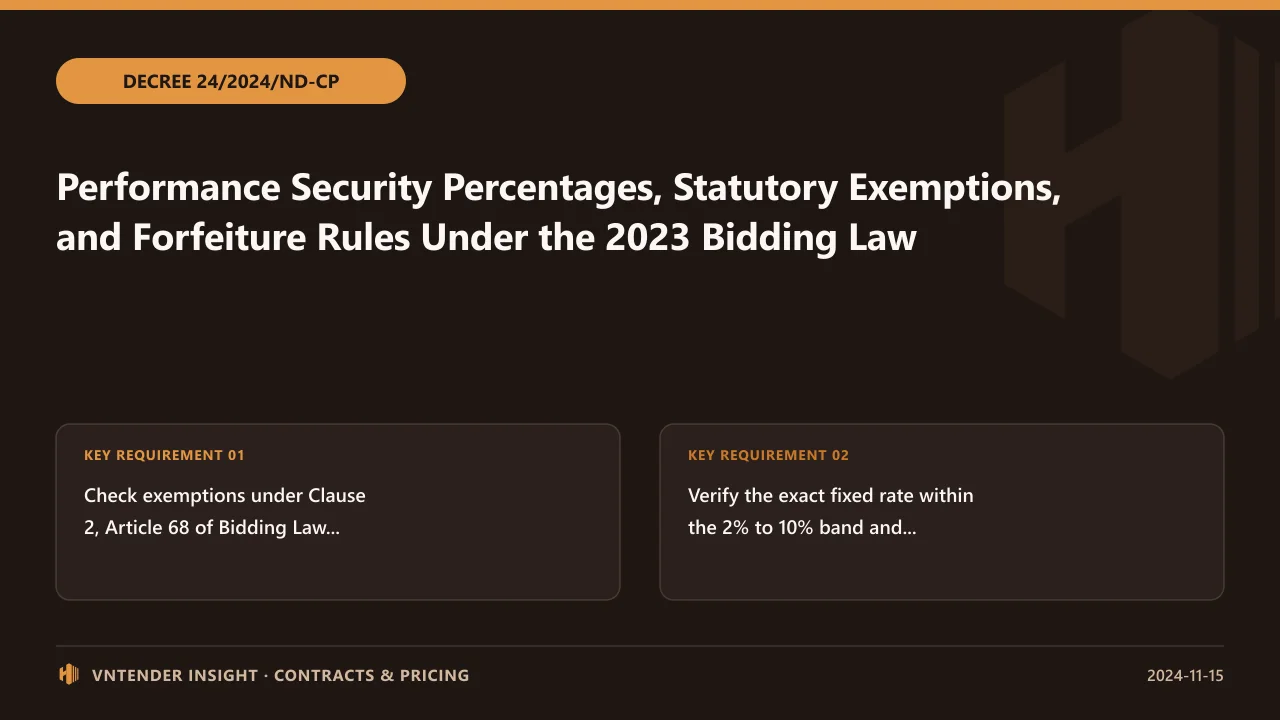
- Key Benchmark: Clause 4, Article 68 sets the performance security band between 2% and 10% of contract price depending on package complexity and risk.
- Execution Control: Track guarantee expiration dates continuously and mandate extensions alongside any schedule addendum.
01Regulatory Context & Core Scope
Performance security is a statutory precondition for contract effectiveness across most civil works, goods, and non-consulting packages. Under Article 68 of Bidding Law 22/2023/QH15, the selected bidder must furnish performance security before the contract enters into force via cash deposit, an unconditional bank guarantee from a licensed domestic institution or foreign bank branch, or a surety insurance certificate.
02Security Validity & Commitment Scope
Clause 4, Article 68 sets the performance security band between 2% and 10% of contract price depending on package complexity and risk. When drafting E-HSMT Special Conditions of Contract under Circular 06/2024/TT-BKHDT, Project Owners must fix one exact percentage: standard goods packages commonly select 2% to 3% to contain financing overhead, while complex works or critical infrastructure packages often set 5% to 10%.
Clause 2, Article 68 grants mandatory exemptions across three categories: consulting-service contractors, contractors selected via self-execution or community participation, and contractors performing packages whose budgets fall within statutory direct-contracting thresholds. Inserting performance-bond requirements into consulting tenders or small direct-contracting packages is a common appraisal error that must be removed before release.
03Effective Dates & Transitional Scope
In duration terms, performance security must remain valid from contract effectiveness until all deliverables are completed, handed over, and transitioned into warranty coverage if required by the contract. Whenever schedules are extended via formal contract addenda, the Project Owner must obtain a matching bank-guarantee extension before the prior expiry date.
Under Clause 6, Article 68 of Bidding Law 22/2023/QH15, performance security is forfeited if the contractor refuses contract performance after effectiveness, breaches contractual obligations, or causes culpable schedule delays while refusing to extend security validity. For state-budget packages, forfeited guarantee proceeds must be remitted promptly to the state treasury.
Performance Security Verification Checklist
- Check exemptions under Clause 2, Article 68 of Bidding Law 2023 before adding bond clauses to E-HSMT.
- Verify the exact fixed rate within the 2% to 10% band and require submission prior to contract effectiveness.
- Inspect unconditional, irrevocable payment wording on bank guarantees or surety insurance certificates.
- Track guarantee expiration dates continuously and mandate extensions alongside any schedule addendum.
Legal Basis & Regulatory Scope
Bidding Law 22/2023/QH15 (Article 68); Decree 24/2024/ND-CP dated 27 February 2024; Circular 06/2024/TT-BKHDT dated 26 April 2024 (Performance Security template).