Key Takeaways
- Governing Scope: Bidding Law 22/2023/QH15 (Articles 68 and 70); Decree 214/2025/ND-CP (Articles 114 and 140).
- Key Benchmark: To resolve unfinished works, Article 140 first tests whether the remaining non-defaulting partners possess sufficient technical and financial capacity.
- Execution Control: Execute performance-bond forfeiture accurately (individual partner share vs. full joint-venture forfeiture) under Article 140 of Decree 214/2025/ND-CP.
01Regulatory Context & Core Scope
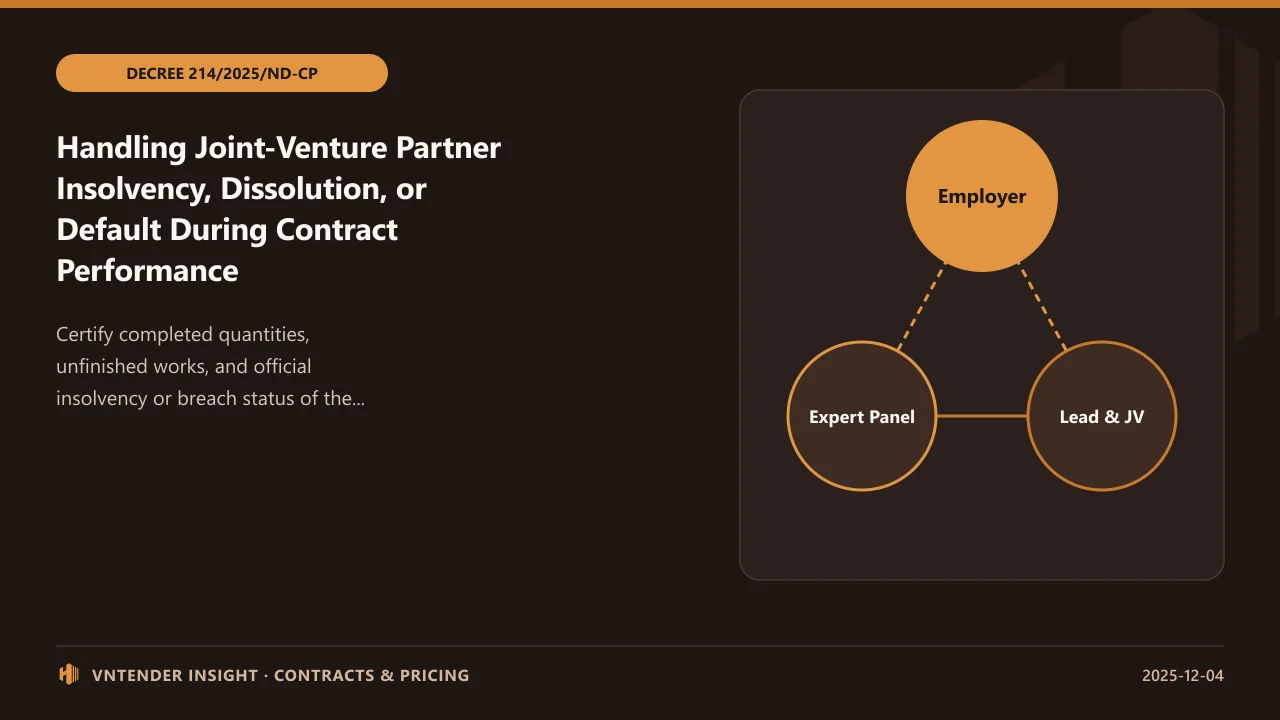
On large multi-partner construction or equipment contracts, the insolvency, dissolution, or operational collapse of one joint-venture member can stall site progress unless the Project Owner executes clear termination rules. Article 140 of Decree 214/2025/ND-CP establishes a granular remedy framework that isolates partner liability while preserving continuity for the package.
Upon confirming that a joint-venture member has entered bankruptcy, dissolved, or materially defaulted, the Project Owner issues a partial termination decision strictly targeting that defaulting partner, imposes contractual penalties, and records contract non-completion against that member alone. Within 5 working days from the termination decision, the Project Owner must publish the partner's breach details on e-GP and notify procurement oversight authorities.
02Qualification Benchmarks & Bidder Preferences
To resolve unfinished works, Article 140 first tests whether the remaining non-defaulting partners possess sufficient technical and financial capacity. Where remaining partners qualify, the Project Owner executes a contract addendum assigning them the unfinished scope alongside their original work packages.
Performance security forfeiture depends strictly on how remaining works are reassigned. Where surviving partners absorb the unfinished scope, the Project Owner forfeits only the defaulting member's performance guarantee share (requiring surviving partners to post supplemental security covering the added value).
03Core Regulatory Provisions & Conditions
Conversely, if surviving partners lack capacity or decline the unfinished scope, forcing the Project Owner to carve out a separate replacement tender, the Project Owner forfeits the performance securities of all joint-venture members.
To prevent accounting bottlenecks during partial termination, Project Owners should verify that joint-venture agreements and performance bonds clearly state each partner's work split and financial share before contract execution.
5-Step Protocol for Defaulting Joint-Venture Partners
- Certify completed quantities, unfinished works, and official insolvency or breach status of the defaulting partner.
- Issue a targeted contract termination notice against the defaulting member and calculate contractual liquidated damages.
- Publish contract non-completion details for the defaulting firm on e-GP within 5 working days of termination.
- Assess technical and financial capacity of surviving joint-venture members to absorb remaining works or carve out a new package.
- Execute performance-bond forfeiture accurately (individual partner share vs. full joint-venture forfeiture) under Article 140 of Decree 214/2025/ND-CP.
Legal Basis & Regulatory Scope
Bidding Law 22/2023/QH15 (Articles 68 and 70); Decree 214/2025/ND-CP (Articles 114 and 140).