Key Takeaways
- Governing Scope: Law on Procurement No. 22/2023/QH15 as amended by Laws No. 57/2024/QH15, 90/2025/QH15, and 142/2025/QH15; Construction Law No. 50/2014/QH13 (Article 146).
- Key Benchmark: Under Clause 2, Article 146 of Construction Law No.
- Execution Control: Document cut-off site measurements, enforce performance bonds, and report contractor default on e-GP upon termination.
01Regulatory Context & Core Scope
Draft contracts in Part 3 of E-HSMT packages are frequently copied verbatim across unrelated projects, producing costly defects in penalty and termination clauses. Some goods tenders mistakenly adopt the 12% public-works penalty cap, while other drafts specify uncapped daily liquidated damages that become legally unenforceable during settlement audits.
02Core Regulatory Provisions & Conditions
Under Clause 2, Article 146 of Construction Law No. 50/2014/QH13, contracts for construction works funded by public investment or state non-public-investment capital may set liquidated damages up to a maximum of 12% of the value of the breached contract portion. Conversely, commercial goods and service contracts governed by Commercial Law No. 36/2005/QH11 face an 8% statutory cap under Article 301 on the breached obligation value, alongside separate actual-damage compensation under Civil Code No. 91/2015/QH13.
To make delay penalties enforceable, draft E-HSMT contracts must specify clear delay triggers measured in calendar days against milestone or completion dates, compute penalties strictly on the delayed scope value rather than already-accepted portions, and tie maximum accumulated delay days or cap exhaustion directly to termination rights.
03Security Validity & Commitment Scope
When a contractor severely defaults on schedule, abandons site works, or loses capability to continue, the investor may terminate the contract for contractor default and re-assign remaining scope under Clauses 22 and 23, Article 140 of Decree No. 214/2025/ND-CP. Upon termination, the investor must execute joint site cut-off measurement minutes, call the performance security, and recover unliquidated advance payments.
Equally important, the investor must publish notice of contractor non-performance due to contractor fault on e-GP within the regulatory deadline under Circular No. 79/2025/TT-BTC. That public record feeds directly into national bid-history screening and triple bid-security checks in future tenders.
Checklist for Penalty Caps and Termination Terms in E-HSMT
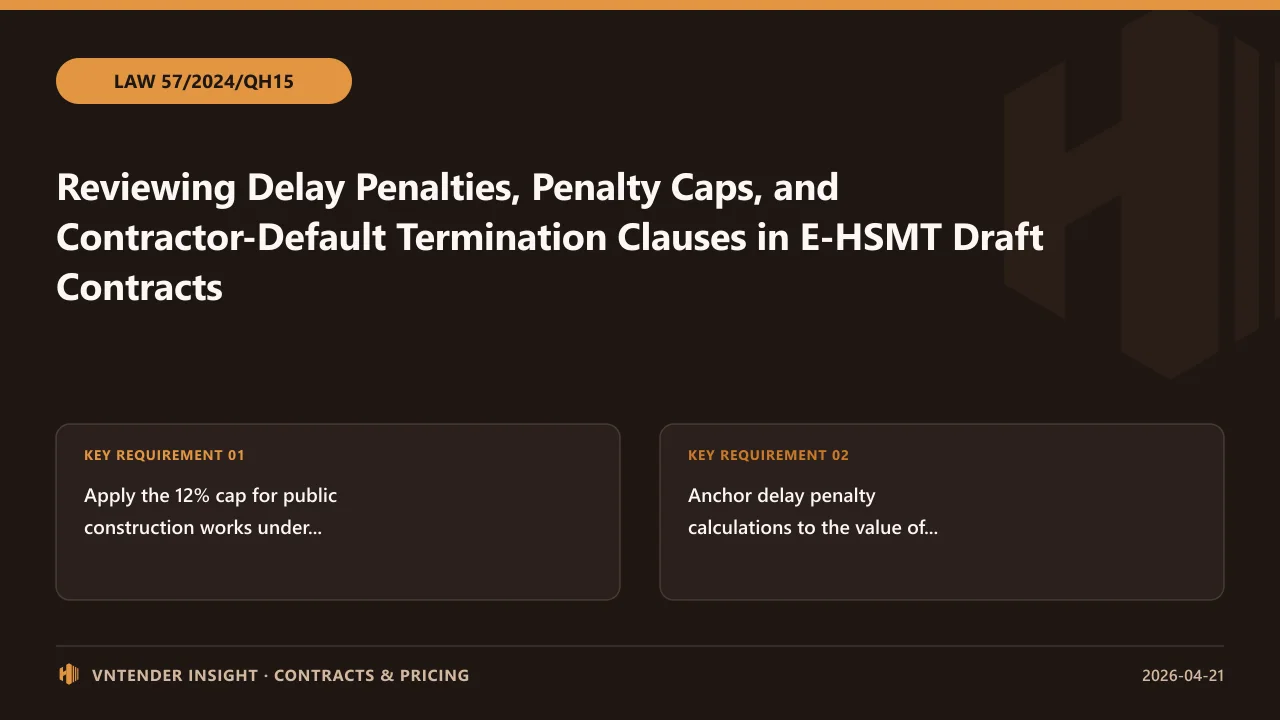
- Apply the 12% cap for public construction works under Article 146 of the Construction Law and the 8% cap for commercial supply contracts under Article 301 of the Commercial Law.
- Anchor delay penalty calculations to the value of uncompleted delayed portions rather than already-accepted deliverables.
- Specify written default notices, cure periods, and unilateral termination triggers once delay thresholds are breached.
- Document cut-off site measurements, enforce performance bonds, and report contractor default on e-GP upon termination.
Legal Basis & Regulatory Scope
Law on Procurement No. 22/2023/QH15 as amended by Laws No. 57/2024/QH15, 90/2025/QH15, and 142/2025/QH15; Construction Law No. 50/2014/QH13 (Article 146); Commercial Law No. 36/2005/QH11 (Article 301); Civil Code No. 91/2015/QH13; Government Decree No. 214/2025/ND-CP dated 04/08/2025 (Article 20; Clauses 22 and 23, Article 140); Ministry of Finance Circular No. 79/2025/TT-BTC dated 04/08/2025.