Key Takeaways
- Governing Scope: Clause 9 of Article 14 and Article 68 of Bidding Law 22/2023/QH15; Articles 18, 43, and 131 of Decree 24/2024/ND-CP.
- Key Benchmark: Archive timestamped e-GP award notices and negotiation invitations to verify expiration of the statutory 10-day deadline.
- Execution Control: Log the untrusted-bidder violation on e-GP under Article 18 of Decree 24/2024 and evaluate inviting the runner-up bidder.
01Regulatory Context & Core Scope
When raw material prices surge after bid opening, a first-ranked or awarded bidder occasionally stalls contract negotiation, refuses finalization, or fails to post performance security. Without strict adherence to statutory notice periods and documentation, procuring entities struggle to draw on bank bid guarantees or smoothly award the package to the runner-up.
02Security Validity & Commitment Scope
Under Clause 9, Article 14 of Bidding Law 22/2023/QH15, bid security is forfeited in three post-selection scenarios absent force majeure: failing or refusing to finalize the contract or framework agreement within 10 days for domestic tenders (20 days for international tenders) after receiving the award notice; refusing to sign the contract within 10 days (20 days international) after contract finalization; or failing to submit required performance security under Article 68 prior to or at contract effectiveness.
Under Article 43 and situational procedures of Decree 24/2024/ND-CP, the procuring entity must issue formal default minutes backed by timestamped e-GP delivery logs of invitations or award notices. After revoking the prior award decision, the Project Owner may invite the next ranked bidder for verification and contract finalization, provided its E-HSDT and bid security remain valid and its price does not exceed the package budget.
03Pricing Methodology & Cost Controls
Alongside lodging a formal written demand on the issuing bank to forfeit the full bid guarantee into the state budget or applicable owner fund, the Project Owner must record the default on e-GP under Article 18 of Decree 24/2024/ND-CP. That untrusted-bidder flag triggers a mandatory triple bid-security requirement on future tenders.
Even where small packages rely on a bid-securing declaration rather than a bank guarantee (under 50,000,000 VND under Circular 22/2024/TT-BKHDT), a defaulting bidder remains legally liable for the declared security sum and faces public e-GP reputation penalties.
Action Plan When the First-Ranked Bidder Defaults on Contracting
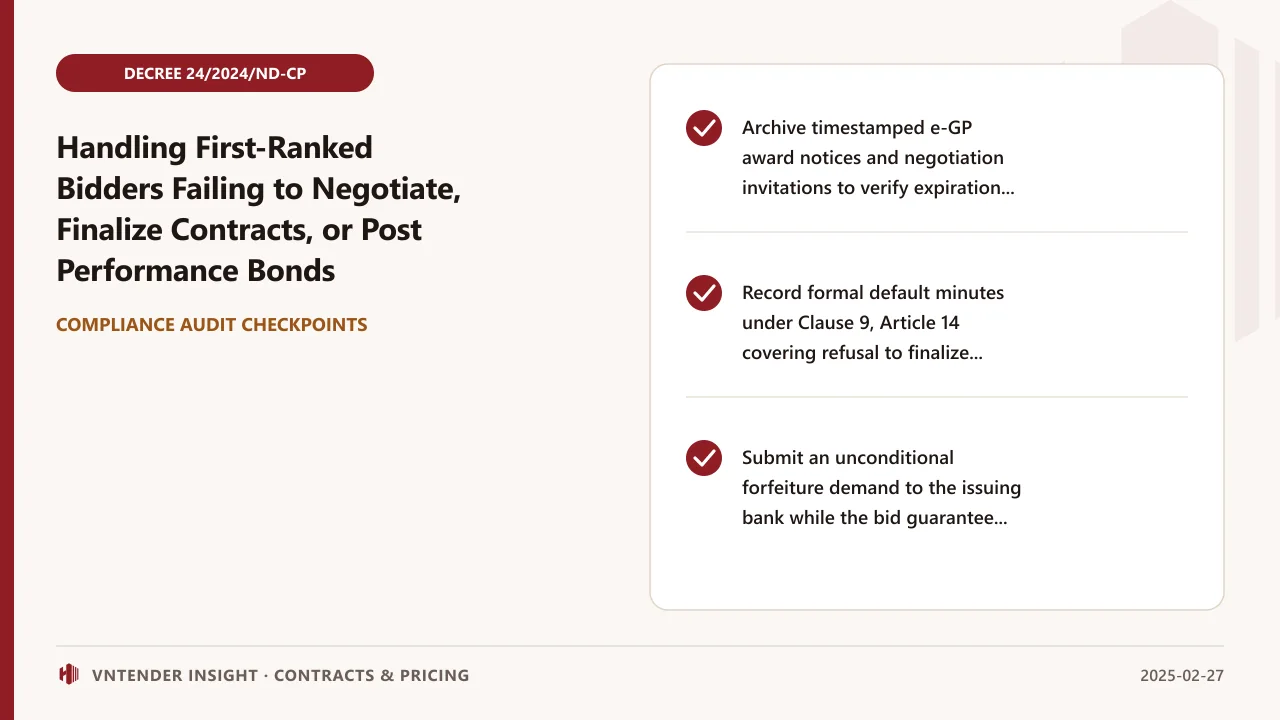
- Archive timestamped e-GP award notices and negotiation invitations to verify expiration of the statutory 10-day deadline.
- Record formal default minutes under Clause 9, Article 14 covering refusal to finalize, execute, or post performance security.
- Submit an unconditional forfeiture demand to the issuing bank while the bid guarantee remains valid.
- Log the untrusted-bidder violation on e-GP under Article 18 of Decree 24/2024 and evaluate inviting the runner-up bidder.
Legal Basis & Regulatory Scope
Clause 9 of Article 14 and Article 68 of Bidding Law 22/2023/QH15; Articles 18, 43, and 131 of Decree 24/2024/ND-CP; Circular 22/2024/TT-BKHDT.