Key Takeaways
- Governing Scope: Clauses 27 and 28 of Article 4 and Clause 8 of Article 16 of Bidding Law 22/2023/QH15; Clause 2, Article 132 of Decree 24/2024/ND-CP.
- Key Benchmark: Delegating work outside approved limits or without consent constitutes prohibited bid transfer under Clause 8, Article 16 of the Bidding Law.
- Execution Control: Obtain written consent from the Project Owner and supervision consultant prior to substituting or adding subcontractors post-award.
01Regulatory Context & Core Scope
On multi-disciplinary construction or integrated equipment packages, main contractors frequently engage specialist firms as subcontractors. Failing to distinguish general subcontractors from special subcontractors when completing e-GP webforms can result in bid disqualification during evaluation or unlawful subcontracting sanctions during execution.
02Qualification Benchmarks & Bidder Preferences
Under Clause 27, Article 4 of Bidding Law 22/2023/QH15, a subcontractor contracts with the main bidder to execute parts of works, consulting, non-consulting, related services, or mixed-package scopes. By contrast, Clause 28, Article 4 defines a special subcontractor as one executing critical package components proposed in the E-HSDT based on explicit qualification criteria set out in the E-HSMT.
Their evaluation treatment differs sharply under Circular 22/2024/TT-BKHDT templates. For general subcontractors, the main bidder must independently satisfy full technical and experience requirements across the entire contract without aggregating the subcontractor credentials, and total subcontracted value must remain within the percentage cap stated in the E-HSMT.
03Core Regulatory Provisions & Conditions
Where E-HSMT permits a special subcontractor for designated critical work, the evaluation panel assesses the special subcontractor credentials directly against that specialized scope, relieving the main bidder from duplicating those specific qualifications. Regardless of subcontractor classification, the main contractor remains fully liable to the Project Owner for overall quality, safety, and schedule compliance.
During contract administration, Point b, Clause 2, Article 132 of Decree 24/2024/ND-CP permits replacing or adding subcontractors only with prior approval from the Project Owner and supervision consultant, provided the total value stays below the contract subcontracting cap and replacement entities meet qualification rules. Delegating work outside approved limits or without consent constitutes prohibited bid transfer under Clause 8, Article 16 of the Bidding Law.
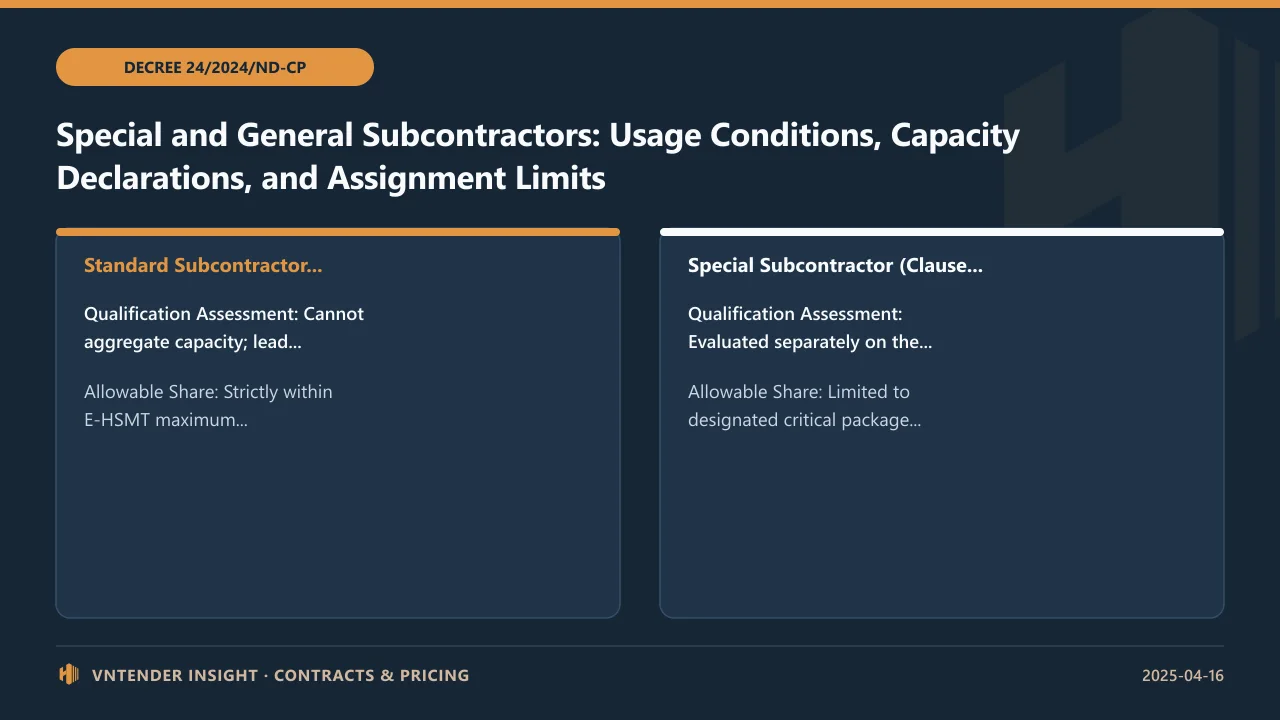
Standard Subcontractor vs Special Subcontractor under Article 4
| Attribute | Standard Subcontractor (Clause 27) | Special Subcontractor (Clause 28) |
|---|---|---|
| Qualification Assessment | Cannot aggregate capacity; lead contractor meets 100% | Evaluated separately on the designated critical scope |
| Allowable Share | Strictly within E-HSMT maximum subcontracting cap | Limited to designated critical package component |
| Post-Award Replacement | Requires Employer & supervision approval (Art. 132) | Unauthorized substitution breaches transfer ban (Clause 8 Art. 16) |
Compliance Checklist for Subcontractor Declaration and Use
- Verify whether the E-HSMT authorizes special subcontractors for critical scopes before relying on their qualifications.
- Ensure aggregate general subcontracting value never exceeds the maximum percentage threshold specified in the E-HSMT and contract.
- Attach signed teaming commitments and verified experience records for any proposed special subcontractor inside the E-HSDT.
- Obtain written consent from the Project Owner and supervision consultant prior to substituting or adding subcontractors post-award.
Legal Basis & Regulatory Scope
Clauses 27 and 28 of Article 4 and Clause 8 of Article 16 of Bidding Law 22/2023/QH15; Clause 2, Article 132 of Decree 24/2024/ND-CP; Circular 22/2024/TT-BKHDT.