Key Takeaways
- Governing Scope: Article 70 of Bidding Law 22/2023/QH15; Article 106 of Decree 24/2024/ND-CP.
- Key Benchmark: Paired with Clause 2, Article 351, an obligor is excused from civil liability when non-performance stems exclusively from force majeure without prior contractor negligence.
- Execution Control: Execute a formal schedule addendum before contract expiration under Article 106 of Decree 24/2024/ND-CP and extend performance bonds.
01Regulatory Context & Core Scope
In imported equipment supply and outdoor infrastructure packages, severe storms, maritime port closures, or sudden foreign export restrictions can delay deliveries beyond contracted deadlines. When disruptions strike, Project Owners and contractors must carefully distinguish genuine objective force majeure entitling schedule extensions and penalty relief from ordinary vendor supply-chain mismanagement.
02Core Regulatory Provisions & Conditions
Under Clause 1, Article 156 of the 2015 Civil Code (Law 91/2015/QH13), force majeure comprises an objective event that is unforeseeable and insurmountable despite applying all necessary and feasible measures. Paired with Clause 2, Article 351, an obligor is excused from civil liability when non-performance stems exclusively from force majeure without prior contractor negligence.
Within procurement law, Clauses 1 and 3, Article 70 of Bidding Law 22/2023/QH15 authorize adjusting contract completion milestones when force majeure or adverse objective circumstances obstruct performance through no fault or negligence of either party. Implementing this rule, Article 106 of Decree 24/2024/ND-CP mandates executing formal contract modification addenda while the underlying contract remains valid and unexpired.
03Evaluation Criteria & Documentary Proof
Procedurally, contractors must notify the Project Owner in writing within the notice period fixed in the Special Conditions of Contract and submit verifiable third-party proof such as official meteorological alerts, carrier port-congestion notices, or foreign customs directives. Crucially, if a contractor placed factory orders late before the storm hit, liquidated damages still apply to the pre-event delay window.
Upon verifying causation and exact delay days attributable solely to force majeure, the Project Owner approves the schedule adjustment, executes an extension addendum before contract expiry, and instructs the contractor to extend performance security validity through the revised completion date.
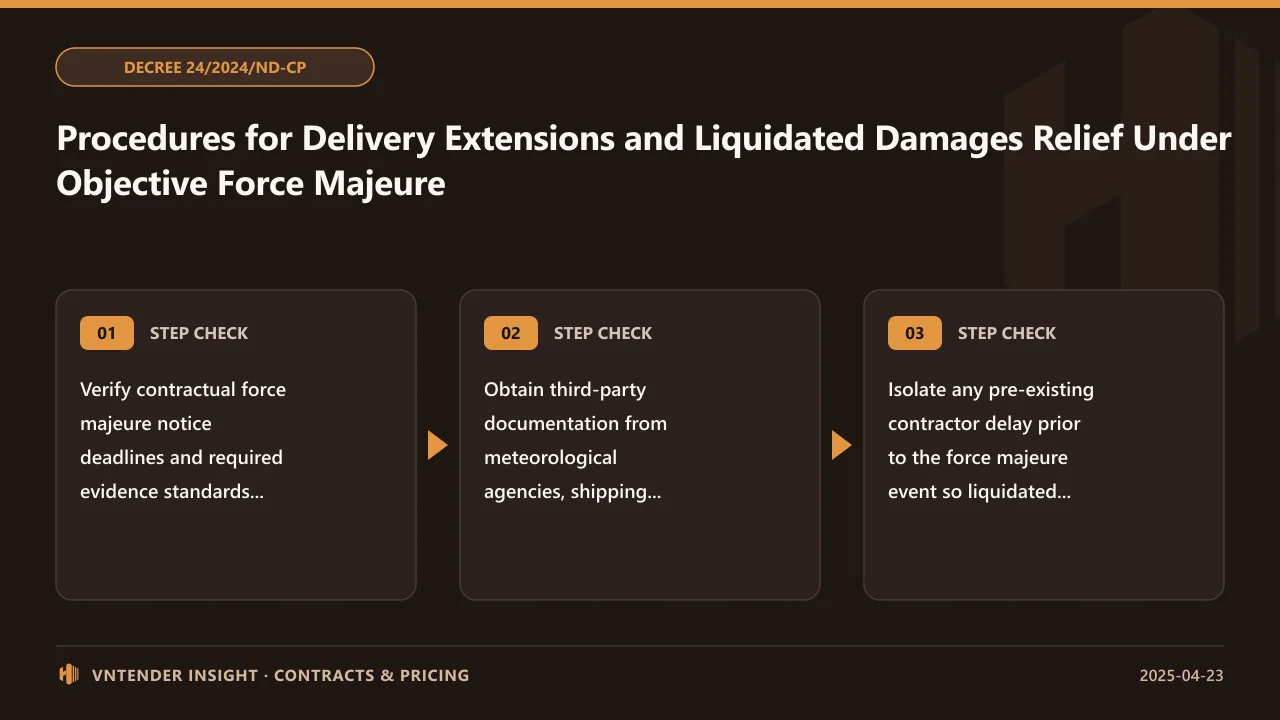
Procedure for Force Majeure Schedule Extensions and Penalty Waivers
- Verify contractual force majeure notice deadlines and required evidence standards inside the Special Conditions of Contract.
- Obtain third-party documentation from meteorological agencies, shipping lines, or export regulators proving insurmountable impact.
- Isolate any pre-existing contractor delay prior to the force majeure event so liquidated damages apply accurately to non-excused days.
- Execute a formal schedule addendum before contract expiration under Article 106 of Decree 24/2024/ND-CP and extend performance bonds.
Legal Basis & Regulatory Scope
Article 70 of Bidding Law 22/2023/QH15; Article 106 of Decree 24/2024/ND-CP; Articles 156 and 351 of Civil Code 91/2015/QH13.