Key Takeaways
- Governing Scope: Point d, Clause 1, Article 43 and Article 66 of Bidding Law 22/2023/QH15; Articles 43 and 100 of Decree 24/2024/ND-CP.
- Key Benchmark: Under Point d, Clause 1, Article 43 of the Bidding Law, contract negotiation remains mandatory for consulting service packages.
- Execution Control: Record finalized contract terms, tax obligations, and schedule details in signed minutes prior to contract execution.
01Regulatory Context & Core Scope
Unlike earlier legislation that mandated contract negotiation across nearly all competitive tenders, Point d, Clause 1, Article 43 of Bidding Law 22/2023/QH15 narrows contract negotiation to shorten award timelines. Distinguishing packages requiring formal negotiation from those proceeding directly to post-award contract finalization prevents procedural delays.
02Core Regulatory Provisions & Conditions
Under Point d, Clause 1, Article 43 of the Bidding Law, contract negotiation remains mandatory for consulting service packages. For goods, works, non-consulting services, and mixed packages, negotiation applies only when necessary for international tenders, mixed contracts, restricted bidding, or technically complex packages; standard domestic goods and works tenders skip separate negotiation and proceed directly to contract finalization after award approval.
Where negotiation applies, Article 43 of Decree 24/2024/ND-CP directs the procuring entity to invite the first-ranked bidder based on the evaluation report, the submitted E-HSDT with clarifications, and the E-HSMT. In standard online quotation procedures under Article 100 of Decree 24/2024/ND-CP, the binding financial baseline reflects the final online bidding price after applicable error corrections.
03Pricing Methodology & Cost Controls
Under Clause 3, Article 43 of Decree 24/2024/ND-CP, parties must not renegotiate terms already compliant with E-HSMT requirements and must never alter unit prices established during financial evaluation. Discussions stay strictly confined to clarifying ambiguous clauses, resolving inconsistencies between E-HSMT and E-HSDT that could trigger disputes, and addressing bidder-identified deviations.
Regarding key personnel, Clause 4, Article 43 prohibits unilateral replacement of proposed staff unless bid evaluation exceeded the scheduled duration in the procurement plan or force majeure occurred, and any substitute must hold equal or superior qualifications without changing the bid price. If the first-ranked bidder fails to attend or refuses to sign negotiation minutes, the Project Owner considers inviting the next ranked bidder.
Safeguards During Contract Negotiation and Finalization
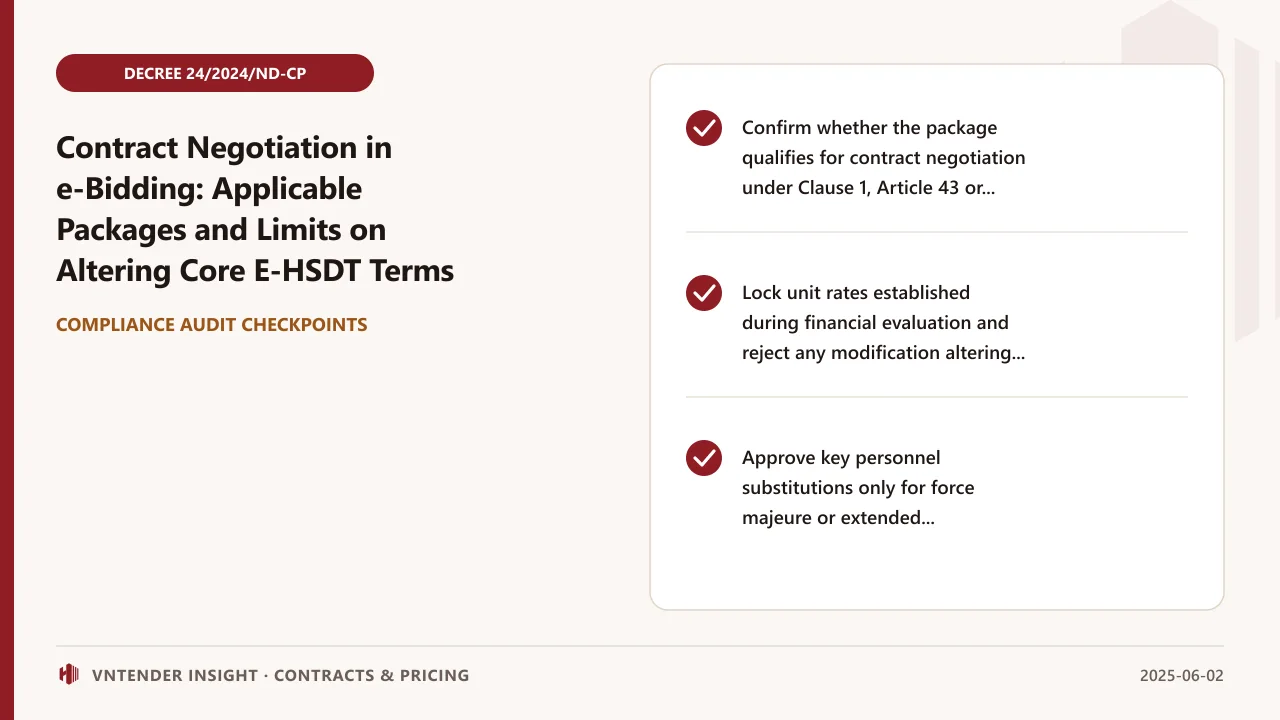
- Confirm whether the package qualifies for contract negotiation under Clause 1, Article 43 or moves straight to contract finalization.
- Lock unit rates established during financial evaluation and reject any modification altering core E-HSDT commitments.
- Approve key personnel substitutions only for force majeure or extended evaluation timelines with verified equal or higher credentials.
- Record finalized contract terms, tax obligations, and schedule details in signed minutes prior to contract execution.
Legal Basis & Regulatory Scope
Point d, Clause 1, Article 43 and Article 66 of Bidding Law 22/2023/QH15; Articles 43 and 100 of Decree 24/2024/ND-CP; Circular 22/2024/TT-BKHDT.