Key Takeaways
- Governing Scope: Bidding Law 22/2023/QH15 (Point c, Clause 2, Article 39; Clause 8, Article 39).
- Key Benchmark: Clause 11, Article 24 of Decree 24/2024/ND-CP further requires the bidding document to specify the maximum optional quantities matching the approved plan.
- Execution Control: Confirm unit prices do not exceed base contract rates and execute the addendum while the contract remains valid.
01Regulatory Context & Core Scope
For pharmaceuticals, medical consumables, and recurring goods with fluctuating demand, the additional purchase option under Clause 8, Article 39 of Bidding Law 22/2023/QH15 enables Project Owners to scale quantities without launching a separate tender. Exercising this flexibility lawfully requires building the option into the procurement plan from the start.
02Pricing Methodology & Cost Controls
Under Point c, Clause 2, Article 39 of Bidding Law 22/2023/QH15, the approved tender package ceiling excludes the value of the additional purchase option, yet the procurement plan must state the estimated quantity and value of that option. Clause 11, Article 24 of Decree 24/2024/ND-CP further requires the bidding document to specify the maximum optional quantities matching the approved plan.
During contract performance, activating the option requires satisfying all five statutory conditions in Point c, Clause 8, Article 39. The contractor must have been selected via open bidding or price negotiation, the additional volume may not exceed 30% of the corresponding contract line-item quantity, and an approved budget estimate must cover the added purchase.
03Contract Performance, Settlement & Amendments
The fourth and fifth conditions strictly govern pricing and timing: unit prices for additional deliveries must not exceed the unit prices signed in the base contract, and the option must be exercised while the primary contract remains valid. Expired contracts or upward unit-price adjustments fall outside the statutory scope of an additional purchase option.
To formalize execution, the parties sign a contract addendum under Article 106 of Decree 24/2024/ND-CP and adjust performance security proportionally if required. In public hospitals, monitoring consumption run-rates monthly ensures the 30% option is executed well before base-contract expiration to prevent supply interruptions.
Five Statutory Conditions for the 30% Additional Purchase Option
| Mandatory Condition | Legal Ceiling | Verification Point |
|---|---|---|
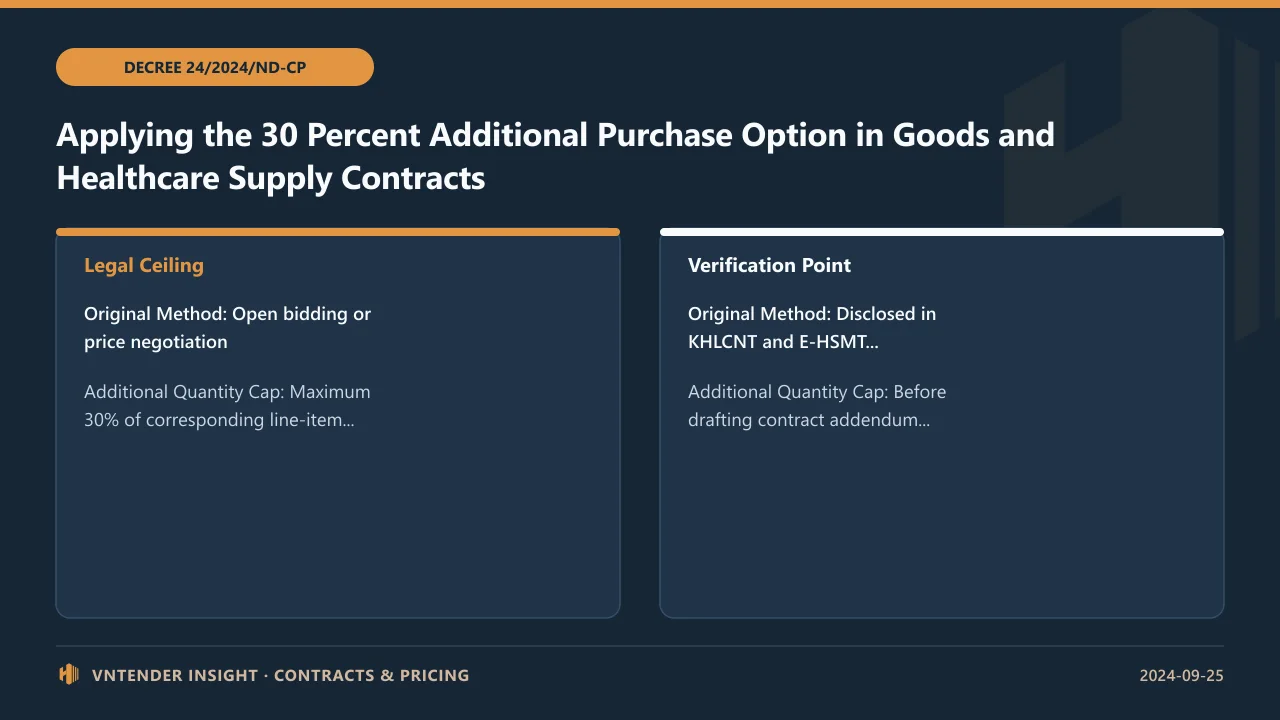
| Original Method | Open bidding or price negotiation | Disclosed in KHLCNT and E-HSMT (excluded from base budget) |
| Additional Quantity Cap | Maximum 30% of corresponding line-item volume | Before drafting contract addendum under Article 106 |
| Unit Price & Contract Validity | Must not exceed signed unit price while base contract active | Prohibited once main contract term expires |
Checklist for Exercising the 30% Option
- Confirm the procurement plan and E-HSMT explicitly stated maximum optional quantities and estimated values.
- Verify the base contract was awarded through open bidding or price negotiation.
- Check that added quantities stay within 30% per contract item and have an approved budget allocation.
- Confirm unit prices do not exceed base contract rates and execute the addendum while the contract remains valid.
Legal Basis & Regulatory Scope
Bidding Law 22/2023/QH15 (Point c, Clause 2, Article 39; Clause 8, Article 39); Decree 24/2024/ND-CP dated 27 February 2024 (Clause 11, Article 24; Article 106).