Key Takeaways
- Governing Scope: Article 21, Clause 5 of Article 32, and Point b of Clauses 2, 3, and 4 of Article 136 of Decree 214/2025/ND-CP (as amended by Article 2 of Decree 349/2026/ND-CP); Cl.
- Key Benchmark: Hold and record panel deliberation minutes before taking a majority vote on contested criteria.
- Execution Control: Have the Appraisal Unit formally examine divergent opinions under Article 136 of Decree 214/2025/ND-CP and state conclusions in Form 3B or 3C.
01Regulatory Context & Core Scope
During evaluations of complex works or technically sensitive equipment tenders, Evaluation Panel members occasionally reach opposing conclusions on whether a bidder passes or fails. Rather than forcing artificial unanimity or suppressing minority views, bidding regulations mandate transparent recording of dissenting opinions to protect individual accountability and inform the approving authority.
02Core Regulatory Provisions & Conditions
Under Clause 5, Article 32 of Decree 214/2025/ND-CP and Form 02A of Circular 134/2026/TT-BTC (governing offline one-envelope packages and guiding detailed divergence tracking alongside Forms 14A, 14B, and 14C of Circular 79/2025/TT-BTC), the panel deliberates collectively and resolves disagreements by majority vote. However, the panel head may not compel any member to retract a reasoned professional position backed by E-HSMT and statutory evidence.
Inside Form 02A of Circular 134/2026/TT-BTC, dissenting positions appear both in the evaluation notes and in the dedicated Section IV Dissenting Opinions five-column table (No., Evaluation Item, Dissenting Opinion, Rationale, and Signature). All panel members (including dissenting members) sign the original paper evaluation report, and for e-GP tenders the panel head uploads a complete scan bearing every member's signature per Clause 3, Article 30 of Circular 79/2025/TT-BTC.
03Procedural Sequence & e-GP Execution
Once an evaluation report records a dissent, mandatory review passes to the Appraisal Unit (where appraisal applies) under Point b of Clauses 2, 3, and 4, Article 136 of Decree 214/2025/ND-CP. The Appraisal Unit must explicitly examine divergent opinions among panel members, convene joint technical meetings where needed, and recommend via Form 3B or 3C of Circular 134/2026/TT-BTC whether the Project Owner should uphold the majority view or direct re-evaluation and bidder clarification.
Project Owners must never strip dissenting pages or request sanitized reports prior to publishing the summary evaluation report on e-GP. Preserving individual scoring sheets, panel deliberation minutes, and Section IV dissent tables cleanly establishes personal accountability in audits and petition reviews.
Checklist for Logging and Resolving Panel Dissenting Opinions
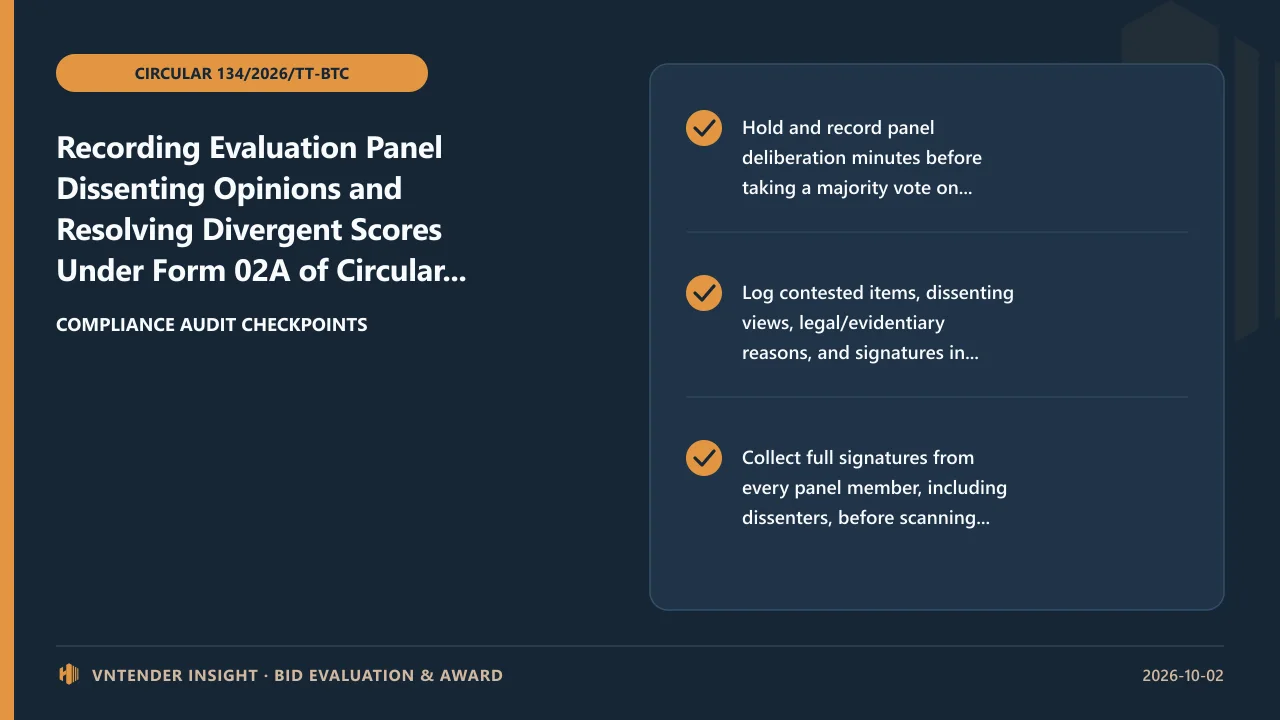
- Hold and record panel deliberation minutes before taking a majority vote on contested criteria.
- Log contested items, dissenting views, legal/evidentiary reasons, and signatures in Section IV of Form 02A under Circular 134/2026/TT-BTC.
- Collect full signatures from every panel member, including dissenters, before scanning and uploading to e-GP.
- Have the Appraisal Unit formally examine divergent opinions under Article 136 of Decree 214/2025/ND-CP and state conclusions in Form 3B or 3C.
Legal Basis & Regulatory Scope
Article 21, Clause 5 of Article 32, and Point b of Clauses 2, 3, and 4 of Article 136 of Decree 214/2025/ND-CP (as amended by Article 2 of Decree 349/2026/ND-CP); Clause 3, Article 30 of Circular 79/2025/TT-BTC; Point a, Clause 2, Article 2 and Forms 02A, 3B, and 3C of Circular 134/2026/TT-BTC.