Key Takeaways
- Governing Scope: Bidding Law 22/2023/QH15; Decree 24/2024/ND-CP.
- Key Benchmark: Do not reject standard banking clauses requiring statutory lending compliance at actual drawdown.
- Execution Control: Check authorized signatory titles and branch authority on the issuing bank letter.
01Regulatory Context & Core Scope
When bidders demonstrate required financial resources through a bank credit commitment letter, evaluation panels often clash over standard banking template phrasing. Distinguishing routine statutory lending conditions from genuine defects in value, package specificity, or validity helps panels avoid wrongful disqualifications and protracted petitions.
02Core Regulatory Provisions & Conditions
Legally, a bank credit promise always includes standard language stating that disbursement upon contract award remains subject to credit rules, collateral verification, and statutory borrowing eligibility at drawdown. Under procurement guidance aligned with Decree 24/2024/ND-CP and Circular 22/2024/TT-BKHDT templates, panels must not reject a bidder solely because the bank includes mandatory banking-law conditions.
A second frequent wording dispute arises when the E-HSMT requires a minimum financial resource amount, whereas the bank letter commits a credit line up to or not exceeding a stated ceiling equal to or above that threshold. Properly construed, a maximum credit ceiling matching or exceeding the E-HSMT minimum still substantiates access to the required liquidity for the contract.
03Evaluation Criteria & Documentary Proof
Conversely, substantive defects invalidate a credit letter unless offset by verified liquid assets: a committed amount below the required financial threshold; a letter expired prior to bid closing; a general working-capital facility failing to earmark funds specifically for the tendered package; or execution by a bank officer lacking lending authority.
Whenever credit wording appears ambiguous regarding dedicated availability for the package, the procuring entity should issue an e-GP clarification request allowing the bidder to submit an explanatory confirmation from the issuing bank. Where clarified proof confirms valid capacity established before bid closing, the financial resource requirement must be marked compliant.
Checklist for Auditing Bank Credit Commitment Letters
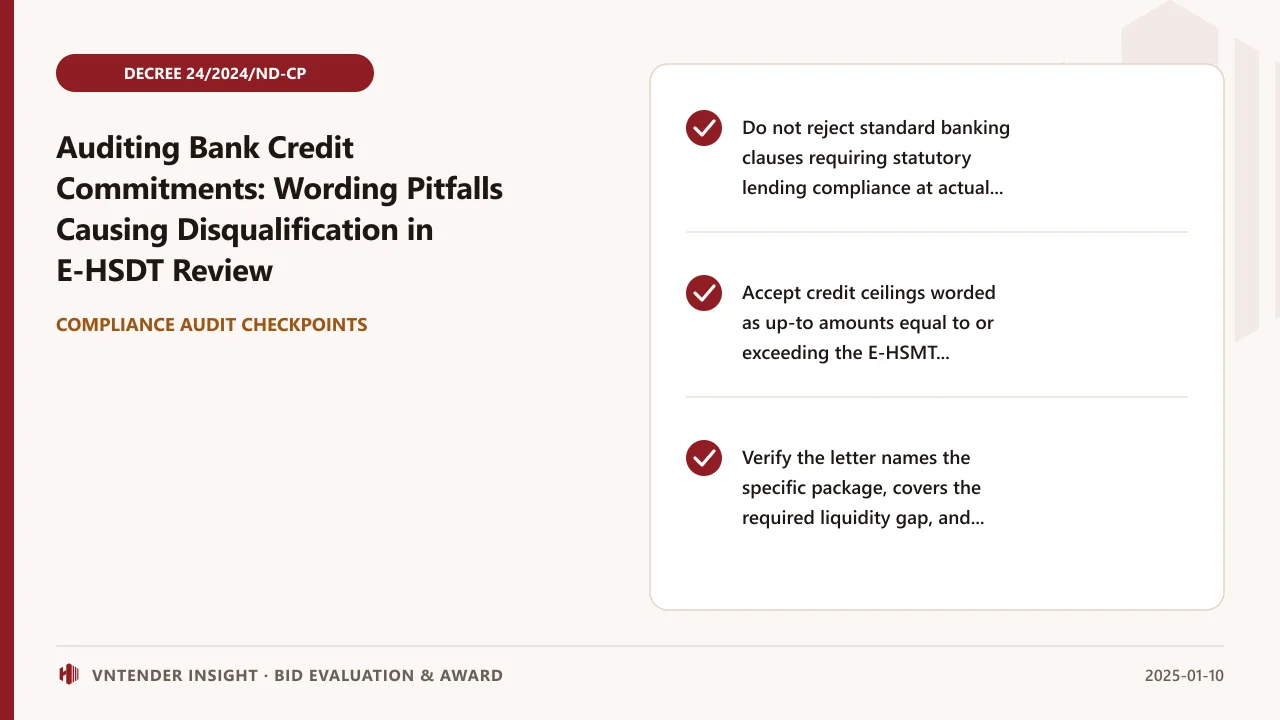
- Do not reject standard banking clauses requiring statutory lending compliance at actual drawdown.
- Accept credit ceilings worded as up-to amounts equal to or exceeding the E-HSMT minimum, seeking clarification if ambiguous.
- Verify the letter names the specific package, covers the required liquidity gap, and remains valid as of bid closing.
- Check authorized signatory titles and branch authority on the issuing bank letter.
Legal Basis & Regulatory Scope
Bidding Law 22/2023/QH15; Decree 24/2024/ND-CP; Circular 22/2024/TT-BKHDT (in full force from 1 January 2025).