Key Takeaways
- Governing Scope: Bidding Law 22/2023/QH15 (Point b, Clause 9, Article 14; Clause 4, Article 16.
- Key Benchmark: Under Clause 5, Article 28 of Decree 24/2024/ND-CP, where document authenticity is doubtful, the Procuring Entity may verify records directly with issuing or contracting parties.
- Execution Control: Submit verified evidence to the Competent Person for 3-to-5-year debarment under Clause 1, Article 125.
01Regulatory Context & Core Scope
Falsified similar contracts, forged construction practice licenses, fabricated VAT invoices, or altered tax notices represent the highest legal compliance risk during E-HSDT evaluation. Whenever inconsistencies appear, such as irregular seal fonts, invalid invoice lookup codes, or mismatched contract numbers, the evaluation panel must run formal third-party verification rather than acting on conjecture.
02Pricing Methodology & Cost Controls
Under Clause 5, Article 28 of Decree 24/2024/ND-CP, where document authenticity is doubtful, the Procuring Entity may verify records directly with issuing or contracting parties. Essential verification channels include former Project Owners, local tax authorities, construction license registries, and banks issuing bid securities or credit letters.
Once written confirmation from the issuing authority proves a record was fabricated, altered to distort figures, or forged, the act constitutes procurement fraud under Clause 4, Article 16 of Bidding Law 22/2023/QH15. For key personnel and machinery, Clause 2, Article 27 of Decree 24/2024/ND-CP strictly prohibits replacement whenever dishonest declaration is proven, requiring immediate bid rejection.
03Security Validity & Commitment Scope
Beyond bid rejection and bid-security forfeiture under Point b, Clause 9, Article 14 of Bidding Law 22/2023/QH15 (where an Article 16 breach or procurement violation forces tender cancellation under Points d and dd, Clauses 1 and 2, Article 17), the Project Owner must escalate the case to the Competent Person under Article 87 of the Bidding Law and Article 125 of Decree 24/2024/ND-CP. Under Clause 1, Article 125, fraud under Clause 4, Article 16 triggers mandatory debarment from participating in procurement activities for 3 to 5 years.
Even when forgery is uncovered after award approval or contract signing, the Competent Person must annul the selection result, terminate the contract where warranted, and publish the debarment decision on e-GP. Archiving formal verification letters, third-party replies, and annotated scan comparisons protects the Project Owner against administrative litigation.
Fraud Verification & Debarment Checklist
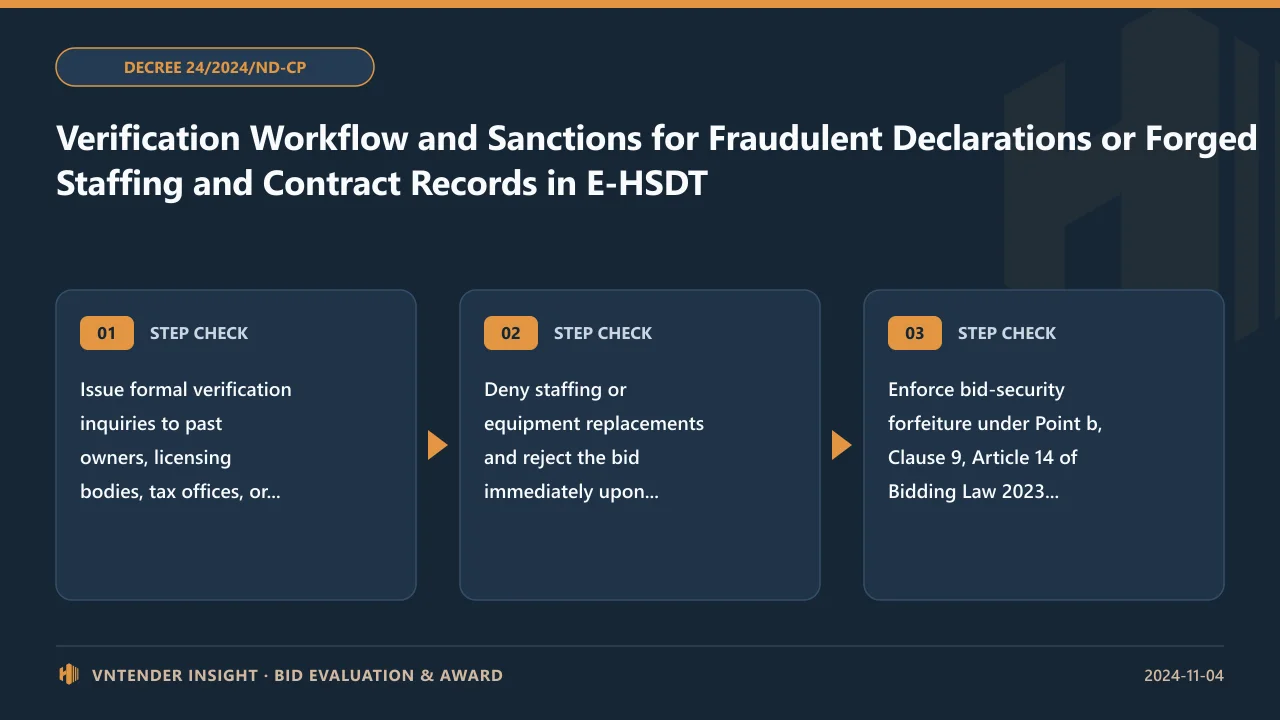
- Issue formal verification inquiries to past owners, licensing bodies, tax offices, or banks under Clause 5, Article 28.
- Deny staffing or equipment replacements and reject the bid immediately upon confirmed fraud under Clause 2, Article 27.
- Enforce bid-security forfeiture under Point b, Clause 9, Article 14 of Bidding Law 2023 where the violation triggers tender cancellation under Article 17.
- Submit verified evidence to the Competent Person for 3-to-5-year debarment under Clause 1, Article 125.
Legal Basis & Regulatory Scope
Bidding Law 22/2023/QH15 (Point b, Clause 9, Article 14; Clause 4, Article 16; Article 17; Article 87); Decree 24/2024/ND-CP dated 27 February 2024 (Clause 2, Article 27; Clause 5, Article 28; Clause 1, Article 125).