Key Takeaways
- Governing Scope: Bidding Law 22/2023/QH15 (Article 16); Decree 214/2025/ND-CP (Articles 29 and 30).
- Key Benchmark: Under Clause 1, Article 27, bidders bear full statutory liability for the accuracy of both webform entries and uploaded files.
- Execution Control: Document two-way verification tables and clarification log references inside the Bid Evaluation Report.
01Regulatory Context & Core Scope
Bid evaluation panels routinely encounter discrepancies between structured data entered on e-GP webforms (or auto-synced vendor profiles) and scanned PDF files attached inside an E-HSDT. Common mismatches include divergent completion dates or contract values on prior similar contracts, misstated years of staff experience, or revenue totals differing from tax-registry feeds.
02Pricing Methodology & Cost Controls
Articles 26 and 27 of Circular 79/2025/TT-BTC establish clear legal responsibilities across webform fields and attachments. Under Clause 1, Article 27, bidders bear full statutory liability for the accuracy of both webform entries and uploaded files. Revenue and net-worth metrics sync automatically from national business and tax registries; any manual reconciliation must align strictly with official tax filings predating bid closing.
When discrepancies surface between webforms and PDF scans, evaluators should avoid immediate fraud disqualification and instead classify the variance under Article 30 of Decree 214/2025/ND-CP. Where an entry reflects a clerical typo (such as mistyping a completion year on the webform while the attached stamped contract and acceptance minute clearly prove completion prior to closing) the panel must issue a clarification request and verify original records.
03Validity Boundaries & Common Evaluation Pitfalls
Two firm legal limits prohibit cure through clarification. First, all underlying legal eligibility records, prior contracts, staff diplomas, and machinery registrations must have existed prior to bid closing; post-closing backdated documents are inadmissible. Second, deliberate inflation of capability metrics unsupported by source records or contradictory core bid price terms falls under prohibited misrepresentation rules in Article 16 of the Bidding Law.
To produce audit-ready evaluation files, panels should record a two-way reconciliation table logging webform values, source-page PDF values, bidder clarification responses, and the verified controlling figure.
Reconciling e-GP Webforms vs. Attached Scans Checklist
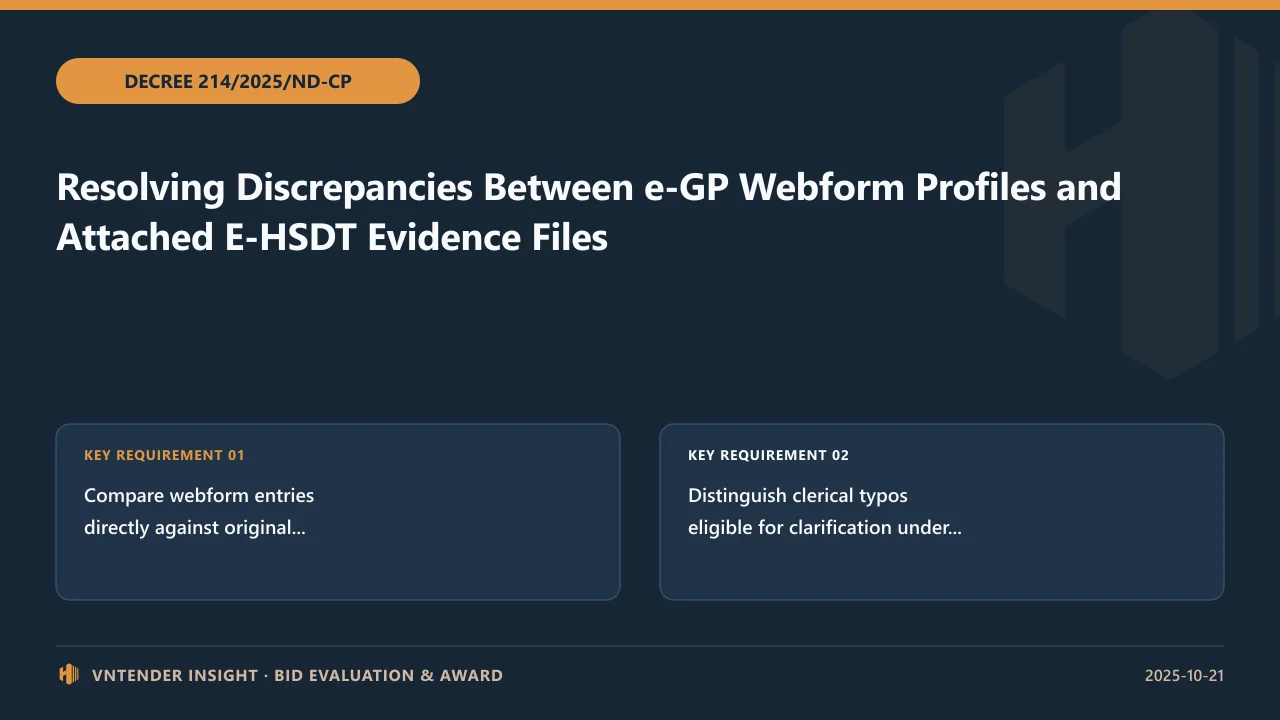
- Compare webform entries directly against original scanned contract pages, acceptance records, licenses, and tax registry feeds.
- Distinguish clerical typos eligible for clarification under Article 30 of Decree 214/2025/ND-CP from fabricated claims.
- Verify that all supporting certificates and contracts existed prior to the published bid-closing timestamp.
- Reject clarifications attempting to alter locked webform unit prices or core technical parameters.
- Document two-way verification tables and clarification log references inside the Bid Evaluation Report.
Legal Basis & Regulatory Scope
Bidding Law 22/2023/QH15 (Article 16); Decree 214/2025/ND-CP (Articles 29 and 30); Circular 79/2025/TT-BTC (Articles 26 and 27).