Key Takeaways
- Governing Scope: Bidding Law 22/2023/QH15 (Article 10, amended by Law 90/2025/QH15); Decree 214/2025/ND-CP (Articles 5, 6, 7, and 8).
- Key Benchmark: Specifically under Article 6, qualifying domestic innovation products enjoy a 6-year preference window starting from initial commercial readiness.
- Execution Control: Grant only the single most favorable preference tier under Article 5 when multiple grounds overlap.
01Regulatory Context & Core Scope
A landmark reform under Law 90/2025/QH15 and Decree 214/2025/ND-CP expands public procurement preferences to support domestic manufacturers, R&D outputs, and innovation startups. Misapplying preference adjustments or overlooking startup financial exemptions can flip final bidder rankings inside evaluation reports.
02Pricing Methodology & Cost Controls
Under amended Points g and i, Clause 1, Article 10 of the Bidding Law, eligible beneficiaries expand to cover innovation startups, science-and-technology organizations, innovation centers, high-tech enterprises, domestic R&D commercialization outputs, and qualifying digital technology products and services.
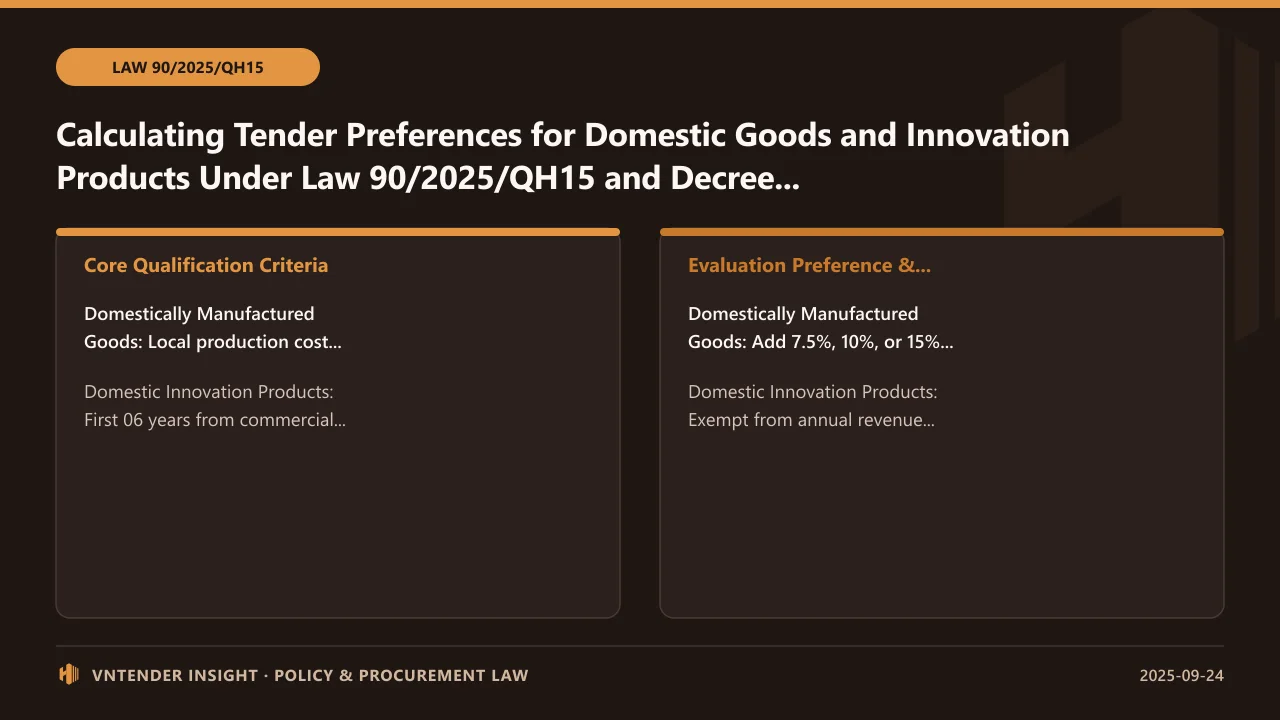
Articles 5 through 8 of Decree 214/2025/ND-CP specify calculation mechanics. Under lowest-price or evaluated-price methods, preference margins (such as 7.5%, 10%, or 15% scaled to domestic production cost ratios of 30% or higher) are added to non-eligible bids solely for ranking comparisons, never altering the actual contract award value. Under combined technical-and-cost scoring, corresponding preference points apply.
03Qualification Benchmarks & Bidder Preferences
Specifically under Article 6, qualifying domestic innovation products enjoy a 6-year preference window starting from initial commercial readiness. Throughout those first six years, domestic startups or individual inventors bidding their own innovation products receive exemptions from traditional annual revenue, net-worth, and operating-history criteria.
Evaluators must enforce Article 5's single-highest-benefit rule whenever a bidder qualifies under multiple categories, and verify official supporting proof such as domestic cost-ratio declarations or science-and-technology product certificates.
Domestic Goods & Innovation Incentives under Decree 214/2025/ND-CP
| Eligible Category | Core Qualification Criteria | Evaluation Preference & Exemption |
|---|---|---|
| Domestically Manufactured Goods | Local production cost ratio >= 30% | Add 7.5%, 10%, or 15% margin for ranking comparison only |
| Domestic Innovation Products | First 06 years from commercial release | Exempt from annual revenue, net worth, and years-of-operation rules |
| Multiple Overlapping Incentives | Article 5 Decree 214/2025/ND-CP | Apply only the single highest preference margin |
Domestic & Innovation Preference Verification Checklist
- Verify bidder and product eligibility under amended Points g and i, Clause 1, Article 10 of the Bidding Law.
- Confirm the 6-year initial commercialization window and apply revenue/operating-history exemptions for innovation startups.
- Audit domestic production cost schedules (30% threshold or above) or science-and-technology certificates.
- Apply preference adjustments strictly for comparative ranking without altering the final contract award amount.
- Grant only the single most favorable preference tier under Article 5 when multiple grounds overlap.
Legal Basis & Regulatory Scope
Bidding Law 22/2023/QH15 (Article 10, amended by Law 90/2025/QH15); Decree 214/2025/ND-CP (Articles 5, 6, 7, and 8).