Key Takeaways
- Governing Scope: Bidding Law 43/2013/QH13 and Decree 63/2014/ND-CP (in force in 2023); Bidding Law 22/2023/QH15 passed 23 June 2023, taking effect on 1 January 2024 (Article 36 on Ma.
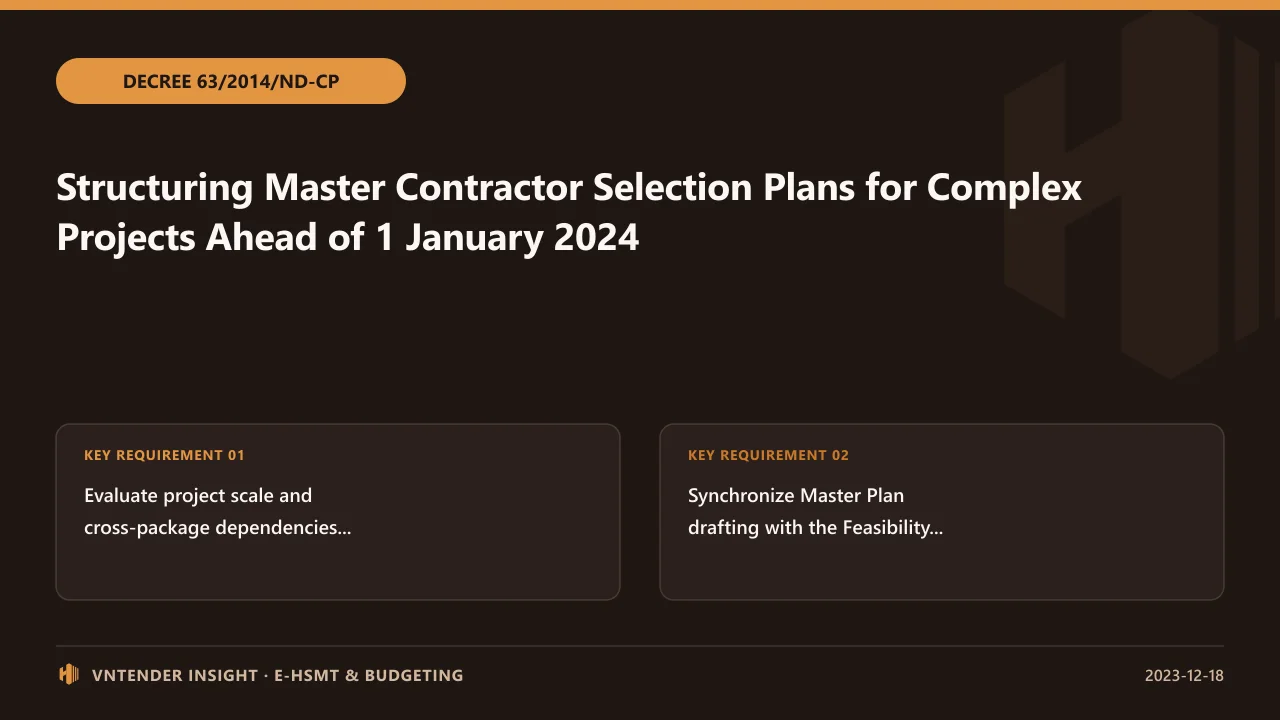
- Key Benchmark: Evaluate project scale and cross-package dependencies to recommend whether a Master Plan should be approved.
- Execution Control: Document long-lead supply chain risks and variance-reporting procedures for subsequent detailed selection plans.
01Regulatory Context & Core Scope
For multi-disciplinary infrastructure or building investments entering 2024, preparing isolated package-by-package selection plans often creates fragmented scopes and interface clashes on site. Addressing this gap under Law 43/2013/QH13, Bidding Law 22/2023/QH15 (effective from 1 January 2024) introduces the Master Contractor Selection Plan under Article 36.
02Pricing Methodology & Cost Controls
Under Article 36 of Bidding Law 22/2023/QH15, a Master Selection Plan is optional rather than universal, determined by the competent person based on project scale and procurement complexity, and applies only to investment projects rather than recurrent operating budgets. It may be prepared alongside or separately from the Feasibility Study Report but can only be approved after the Feasibility Study is signed off.
Clause 3, Article 36 sets out five core sections: assessing legal, economic, technical, and market readiness factors; evaluating the Project Owner's procurement capacity and track record; identifying supply, price, and schedule risks; establishing clear competition and value-for-money goals; and proposing package bundling, selection methods, contract types, and risk-allocation rules.
03Procedural Sequence & e-GP Execution
Once approved, subsequent detailed Contractor Selection Plans must align with the Master Plan. Where changing site conditions require deviations in a detailed package plan, the Project Owner reports the variance to the competent authority for targeted approval without reopening the entire Master Plan.
During year-end project preparation in December 2023, Hoang Quan Construction Development Investment Consulting Co., Ltd. advises project owners managing linked design, equipment, and civil works packages to evaluate adopting a Master Plan as Law 22/2023/QH15 takes effect.
Preparation Checklist for Master Contractor Selection Plans
- Evaluate project scale and cross-package dependencies to recommend whether a Master Plan should be approved.
- Synchronize Master Plan drafting with the Feasibility Study and schedule final approval after project investment sign-off.
- Compile historical tender savings rates, bidder turnout metrics, and internal Project Owner procurement staffing data.
- Document long-lead supply chain risks and variance-reporting procedures for subsequent detailed selection plans.
Legal Basis & Regulatory Scope
Bidding Law 43/2013/QH13 and Decree 63/2014/ND-CP (in force in 2023); Bidding Law 22/2023/QH15 passed 23 June 2023, taking effect on 1 January 2024 (Article 36 on Master Contractor Selection Plans).