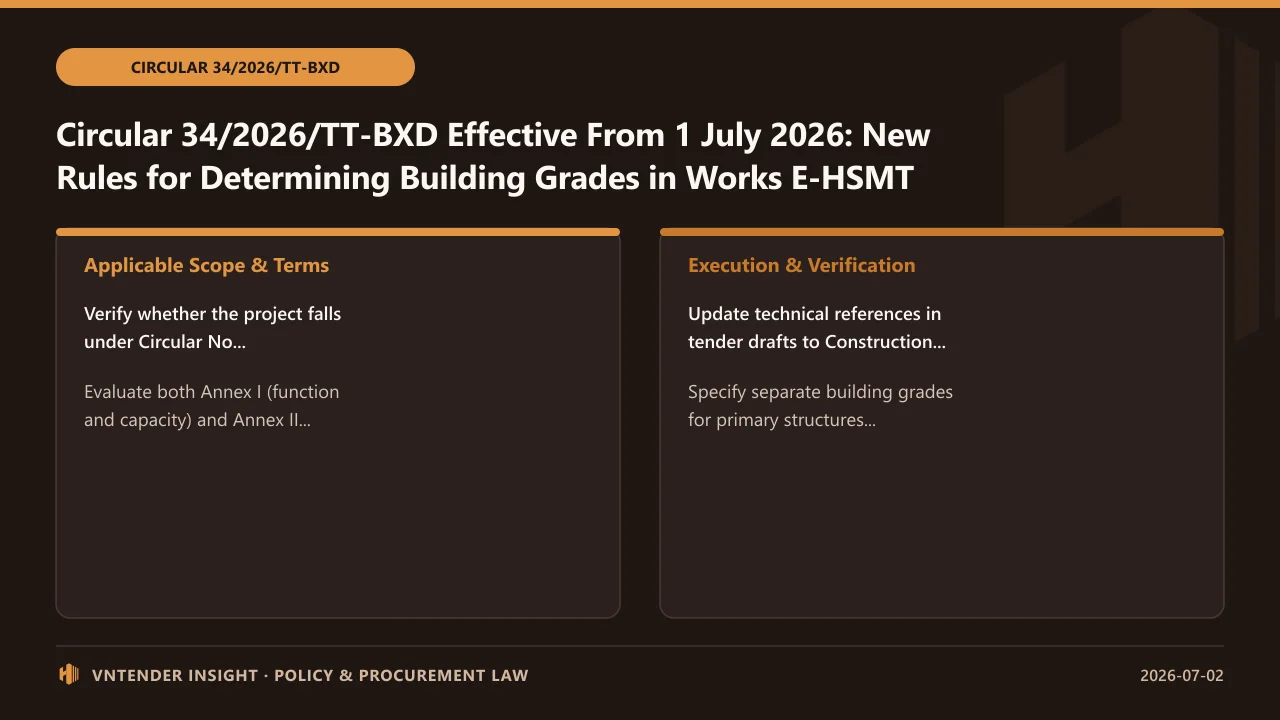
Key Takeaways
- Governing Scope: Construction Law No. 135/2025/QH15 (Point a, Clause 2, Article 6); Ministry of Construction Circular No. 34/2026/TT-BXD dated 25/06/2026, effective 01/07/2026 (Artic.
- Key Benchmark: Under Clauses 1 and 2, Article 2 of Circular No.
- Execution Control: Specify separate building grades for primary structures whenever a tender combines distinct facility types.
01Regulatory Context & Core Scope
Effective on 01/07/2026, Ministry of Construction Circular No. 34/2026/TT-BXD dated 25/06/2026 enters into force alongside the main operational provisions of Construction Law No. 135/2025/QH15. Replacing earlier building-grade regulations from the Ministry of Construction, the Circular establishes a unified classification baseline across design appraisal, permitting, acceptance inspection, and capability thresholds in works E-HSMT tenders.
02Qualification Benchmarks & Bidder Preferences
Under Clauses 1 and 2, Article 2 of Circular No. 34/2026/TT-BXD, the grade of an independent structure is determined across two parallel dimensions: importance and capacity scale under Annex I, and structural scale under Annex II. Where a standalone structure meets different grade thresholds across the two annexes or individual criteria, the highest resulting grade governs.
Article 3 of Circular No. 34/2026/TT-BXD connects building grades directly to statutory management controls, including agency appraisal jurisdiction, acceptance-inspection oversight, firm capability and individual practicing certificates, consulting cost norms, and facility maintenance. For e-GP procurement, that classification establishes the mandatory anchor for similar-contract and key-personnel criteria under Circular No. 79/2025/TT-BTC forms.
03Core Regulatory Provisions & Conditions
Where a package covers a multi-structure complex or interconnected process line, E-HSMT drafters must examine each core structure separately rather than allowing an ancillary shed to lower the grade or an isolated specialty feature to inflate the entire package. If a tender spans multiple works grades, Chapter III should specify each work type and grade aligned with the primary scope so bidders submit matching reference contracts.
From 01/07/2026 onward, Project Management Boards should update their E-HSMT drafting checklists to cite Construction Law No. 135/2025/QH15 and Circular No. 34/2026/TT-BXD for newly approved projects while verifying Article 5 transitional applicability for projects approved before the effective date.
Works E-HSMT Checklist Effective 1 July 2026
- Verify whether the project falls under Circular No. 34/2026/TT-BXD directly or under Article 5 transitional provisions.
- Evaluate both Annex I (function and capacity) and Annex II (structural scale) and assign the highest grade for each standalone structure.
- Update technical references in tender drafts to Construction Law No. 135/2025/QH15 and Circular No. 34/2026/TT-BXD.
- Specify separate building grades for primary structures whenever a tender combines distinct facility types.
Legal Basis & Regulatory Scope
Construction Law No. 135/2025/QH15 (Point a, Clause 2, Article 6); Ministry of Construction Circular No. 34/2026/TT-BXD dated 25/06/2026, effective 01/07/2026 (Articles 1 through 5, Annex I, and Annex II); Law on Procurement No. 22/2023/QH15; Ministry of Finance Circular No. 79/2025/TT-BTC dated 04/08/2025.