Key Takeaways
- Governing Scope: Bidding Law 22/2023/QH15 (Clause 3, Article 44); Decree 24/2024/ND-CP dated 27 February 2024 (Articles 16 and 24).
- Key Benchmark: Separate budget-funded service tenders (Bidding Law) from commercial premise leasing (Decree 151/2017/ND-CP).
- Execution Control: Specify responsibility for utility charges and kitchen equipment upkeep clearly inside budgets and contracts.
01Regulatory Context & Core Scope
At the start of each academic year, public schools commonly procure three campus services concurrently: student boarding meals, bicycle and motorbike parking, and routine cleaning or security. A frequent compliance error is forcing all three under a single procedural track, confusing Bidding Law 22/2023/QH15 procurement rules with public-asset management rules under Law 15/2017/QH14.
02Security Validity & Commitment Scope
Where a school uses state budget allocations or authorized tuition revenue to purchase prepared student meals, food supplies, cleaning, or campus security directly, the package is governed by Bidding Law 22/2023/QH15 and Decree 24/2024/ND-CP. E-HSMT packages use Forms 5A or 5B of Circular 06/2024/TT-BKHDT, emphasizing food-safety licensing, ingredient traceability, one-way kitchen hygiene workflows, and liability insurance.
Conversely, where an outside operator uses school grounds for student parking or a canteen and collects user fees directly rather than receiving school budget payments, legal compliance follows auxiliary public-asset utilization rules under Law 15/2017/QH14 and Decree 151/2017/ND-CP. Pure commercial space leasing unrelated to educational support duties requires an approved leasing scheme and statutory public auction.
03Qualification Benchmarks & Bidder Preferences
For school-meal tenders under Bidding Law 22/2023/QH15, technical clauses must stay stringent yet non-restrictive under Clause 3, Article 44: requiring valid food-safety certificates, 24-hour meal-sample retention logs, age-appropriate nutritional menus, and emergency response plans. E-HSMT terms must never restrict bidder registration strictly to the host district when neighboring caterers satisfy hot-food transport time limits.
Because daily meal counts fluctuate with student attendance, fixed-unit-price contracts work far better than lump-sum contracts, tying monthly payments to daily attendance logs signed by the school nurse and leadership. Early procurement planning should also clarify responsibility for kitchen utilities and equipment maintenance whenever school facilities are used.
Public School Service Procurement Checklist
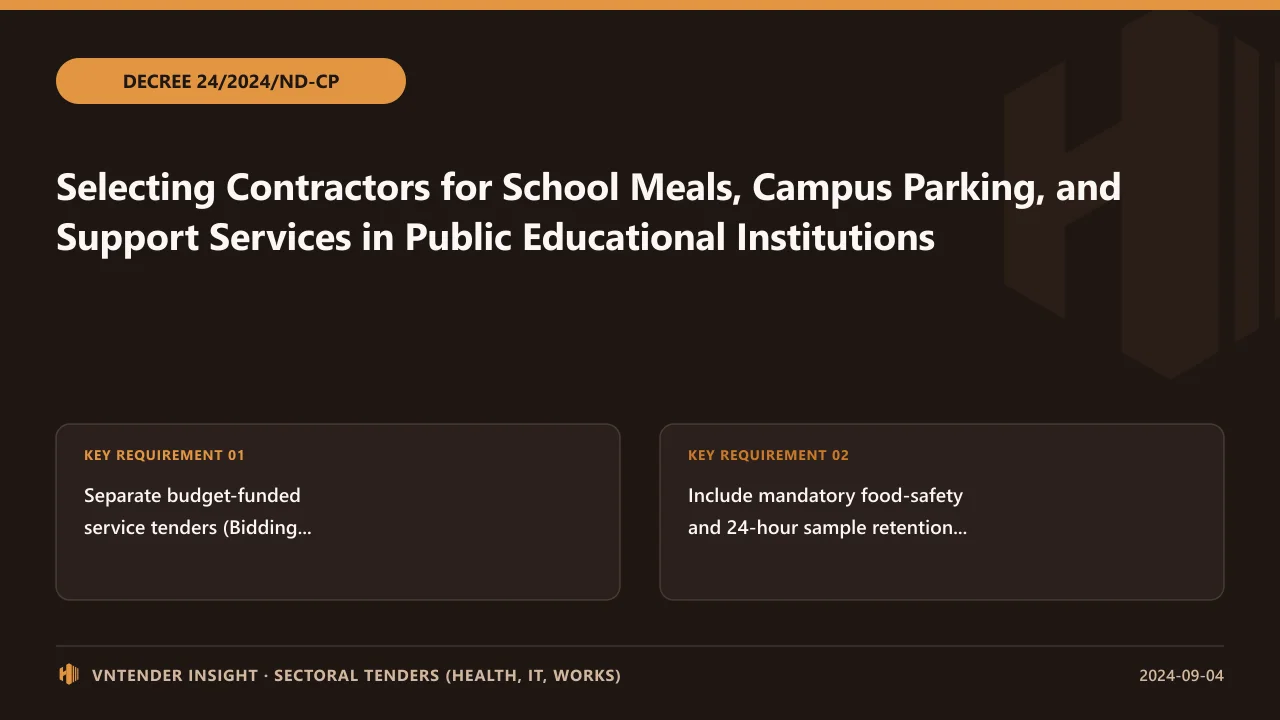
- Separate budget-funded service tenders (Bidding Law) from commercial premise leasing (Decree 151/2017/ND-CP).
- Include mandatory food-safety and 24-hour sample retention criteria without geographic district restrictions.
- Select fixed-unit-price contracts so monthly payments track verified daily meal headcounts.
- Specify responsibility for utility charges and kitchen equipment upkeep clearly inside budgets and contracts.
Legal Basis & Regulatory Scope
Bidding Law 22/2023/QH15 (Clause 3, Article 44); Decree 24/2024/ND-CP dated 27 February 2024 (Articles 16 and 24); Circular 06/2024/TT-BKHDT (Clause 5, Article 4; Forms 5A and 5B); Law on Management and Use of Public Assets 15/2017/QH14; Decree 151/2017/ND-CP dated 26 December 2017.