Key Takeaways
- Governing Scope: Bidding Law 43/2013/QH13 (Article 1, in force in 2023); Bidding Law 22/2023/QH15 passed 23 June 2023, taking effect on 1 January 2024 (Articles 2 and 6).
- Key Benchmark: However, second-tier subsidiaries over 50% owned by the State that qualify as SOEs under the Law on Enterprises still fall squarely under Point a, Clause 2, Article 2.
- Execution Control: Review Article 6 competition independence rules whenever subsidiaries bid on packages issued by parent enterprises.
01Regulatory Context & Core Scope
Under Bidding Law 43/2013/QH13, determining whether state-invested enterprises had to apply statutory procurement rules frequently triggered disputes around capital-mix thresholds. Specifically, Point c, Clause 1, Article 1 of Law 43/2013/QH13 applied the law to development investment projects using state or SOE capital of at least 30%, or under 30% where exceeding VND 500 billion.
02Core Regulatory Provisions & Conditions
To resolve blended-funding ambiguity and tighten oversight across second-tier entities, Bidding Law 22/2023/QH15, passed on 23 June 2023 and taking effect on 1 January 2024, restructures corporate coverage under Clause 2, Article 2. Point a mandates statutory procurement for all packages under investment projects of state-owned enterprises under the Law on Enterprises and enterprises wholly owned (100% charter capital) by an SOE, regardless of whether financing comes from commercial loans or equity.
In addition, Point b, Clause 2, Article 2 of Law 22/2023/QH15 explicitly captures packages procuring technical facilities, machinery, and equipment financed from an SOE's Science and Technology Development Fund. This closes an oversight gap where substantial internal fund expenditures previously bypassed formal tender procedures.
03Pricing Methodology & Cost Controls
Conversely, joint-stock or affiliated entities below full SOE ownership executing projects outside public investment under Article 2 gain autonomy to operate under internal procurement regulations rather than the old 30% capital rule. However, second-tier subsidiaries over 50% owned by the State that qualify as SOEs under the Law on Enterprises still fall squarely under Point a, Clause 2, Article 2.
For state economic groups planning 2024 procurement calendars, VNTender advises auditing equity ownership tables across all subsidiaries immediately and separating investment-project tenders from routine commercial procurement.
Checklist for SOE and Subsidiary Procurement Scope Ahead of 2024
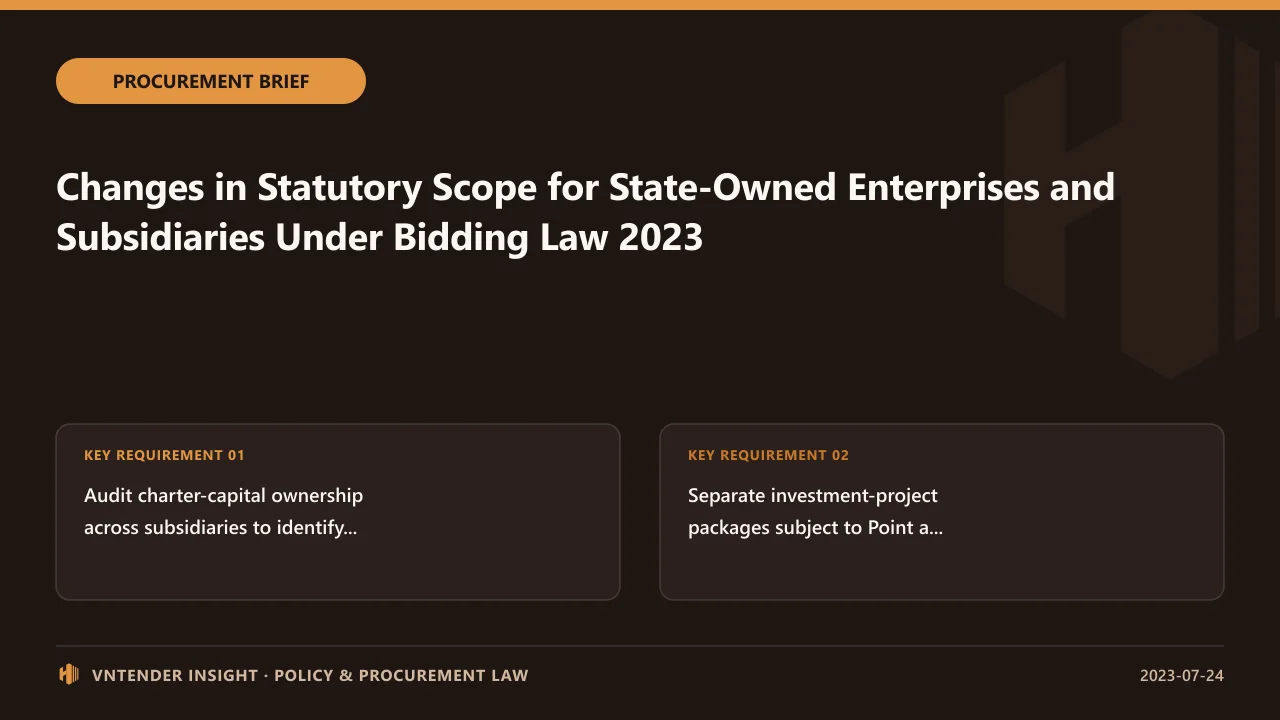
- Audit charter-capital ownership across subsidiaries to identify SOEs and wholly SOE-owned entities.
- Separate investment-project packages subject to Point a, Clause 2, Article 2 from routine commercial operating purchases.
- Flag planned equipment purchases using the SOE Science and Technology Development Fund for 2024 statutory tender planning.
- Review Article 6 competition independence rules whenever subsidiaries bid on packages issued by parent enterprises.
Legal Basis & Regulatory Scope
Bidding Law 43/2013/QH13 (Article 1, in force in 2023); Bidding Law 22/2023/QH15 passed 23 June 2023, taking effect on 1 January 2024 (Articles 2 and 6).