Key Takeaways
- Governing Scope: Bidding Law 43/2013/QH13 (Article 89, in force in 2023); Bidding Law 22/2023/QH15 passed 23 June 2023, taking effect on 1 January 2024 (Article 16).
- Key Benchmark: Verify approved funding allocations or lawful financing sources before publishing any tender notice.
- Execution Control: Monitor declared subcontracting shares across bids and signed contracts against the 10% unlawful-transfer threshold.
01Regulatory Context & Core Scope
Within Bidding Law 22/2023/QH15, passed on 23 June 2023 and taking effect on 1 January 2024, Article 16 establishes the core integrity framework replacing Article 89 of Bidding Law 43/2013/QH13. It classifies 09 prohibited conduct groups governing Project Owners, procuring entities, evaluation panels, appraisal teams, and bidders.
02Security Validity & Commitment Scope
The first five groups target corruption, collusion, and fraud: giving, receiving, or brokering bribes; abusing official power to interfere illegally in procurement; bid rigging through coordinated submission, withdrawal, supply refusal, or withholding qualification proof to favor another bidder; falsifying or misrepresenting records; and obstruction, including concealing evidence, harassing participants, or breaching cybersecurity to disrupt online tendering.
The sixth group prohibits breaches of fairness and transparency, including conflict-of-interest participation between tender drafters or appraisers and competing bidders, as well as tailoring specifications to favor pre-selected suppliers. The seventh group bans unauthorized disclosure of evaluation records and confidential tender details before statutory release.
03Core Regulatory Provisions & Conditions
The eighth group tightens contract execution discipline by banning unlawful subcontracting transfers, defined as transferring 10% or more of contract value to another party, or less than 10% where exceeding the share declared in the signed contract. The ninth group prohibits launching contractor selection before identifying funding sources to pay for the package, curbing public construction arrears.
Mapping these 09 categories ahead of 2024 enables Project Owners and contractors to strengthen internal compliance controls. At VNTender, independent staff declarations, document authenticity checks, and funding-source verification form standard pre-publication checks.
Compliance Checklist for the 09 Prohibited Conduct Groups
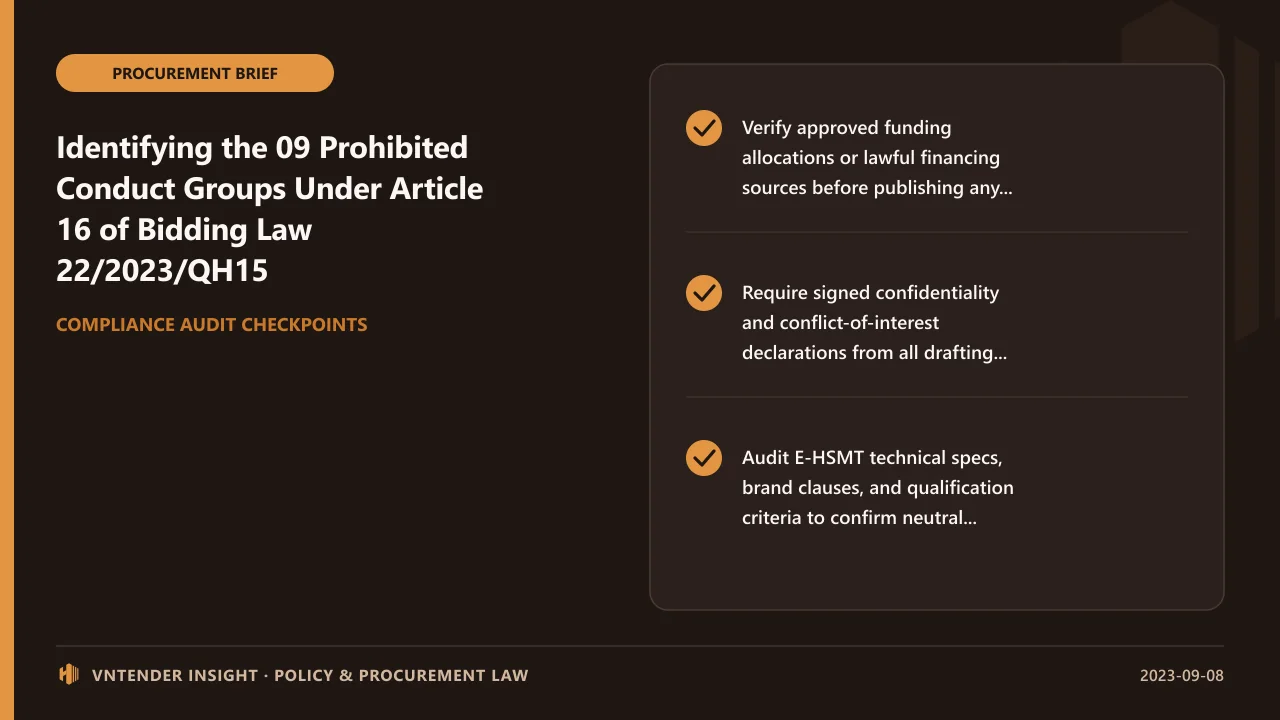
- Verify approved funding allocations or lawful financing sources before publishing any tender notice.
- Require signed confidentiality and conflict-of-interest declarations from all drafting, evaluation, and appraisal personnel.
- Audit E-HSMT technical specs, brand clauses, and qualification criteria to confirm neutral, competitive wording.
- Monitor declared subcontracting shares across bids and signed contracts against the 10% unlawful-transfer threshold.
Legal Basis & Regulatory Scope
Bidding Law 43/2013/QH13 (Article 89, in force in 2023); Bidding Law 22/2023/QH15 passed 23 June 2023, taking effect on 1 January 2024 (Article 16).