Key Takeaways
- Governing Scope: Bidding Law 43/2013/QH13; Decree 63/2014/ND-CP (Articles 16 and 18).
- Key Benchmark: Reject immediately for core Article 18 Decree 63/2014/ND-CP defects in bid letters, validity durations, bid securities, or duplicate bids.
- Execution Control: Ensure post-opening clarifications never alter the bidder's legal identity or modify submitted tender prices.
01Regulatory Context & Core Scope
During E-HSDT validity screening in 2023 tenders, Bid Evaluation Panels regularly walk a fine line between preserving competition through clarifications and rejecting bids with fatal compliance defects. Disqualifying a bidder over a minor curable omission invites formal protests, whereas allowing post-closing repairs to core validity conditions violates equal treatment.
02Security Validity & Commitment Scope
Article 18 of Decree 63/2014/ND-CP establishes strict mandatory validity thresholds: a valid original submission on e-GP, a properly executed bid letter free of adverse conditions, sufficient bid validity duration, compliant bid security value and period, single-bid participation per package, legal eligibility, competition independence, and absence of debarment. Failing any of these core rules mandates immediate rejection.
Conversely, where supporting documents proving eligibility, financial capacity, or prior experience are missing or ambiguous, Article 16 of Decree 63/2014/ND-CP empowers the procuring entity to request written clarification—and even lets bidders submit missing qualification documents proactively after closing—provided neither the bidder's legal identity nor the bid price changes.
03Qualification Benchmarks & Bidder Preferences
A common pitfall on e-GP involves construction practicing capability certificates in civil works bids. Article 28 of Circular 08/2022/TT-BKHDT explicitly rules that omitting a construction capability certificate from an E-HSDT is never grounds for rejection even when listed in the E-HSMT; the bid continues through evaluation and the certificate is verified prior to contract signing upon award.
Inside formal evaluation reports, panels should distinguish fatal breaches under Article 18 of Decree 63/2014/ND-CP (such as insufficient bid security or conflicting bid prices) from clarifiable omissions under Article 16 and Article 28 of Circular 08/2022/TT-BKHDT, protecting award rulings from challenges.
Fatal Validity Errors vs Clarifiable Omissions (2023 Transitional Baseline)
| Dossier Situation | Governing Rule | Evaluation Panel Action |
|---|---|---|
| Invalid bid letter, insufficient bid security, dual prices | Article 18 Decree 63/2014/ND-CP | Mandatory condition: immediate rejection without clarification |
| Missing capacity records or past contract certificates | Article 16 Decree 63/2014/ND-CP | Request clarification or supplemental evidence preserving bid price |
| Unattached Construction Capability Certificate | Article 28 Circular 08/2022/TT-BKHPT | Do not disqualify; verify certificate prior to contract signing |
Checklist Separating Fatal Validity Defects From Clarifications
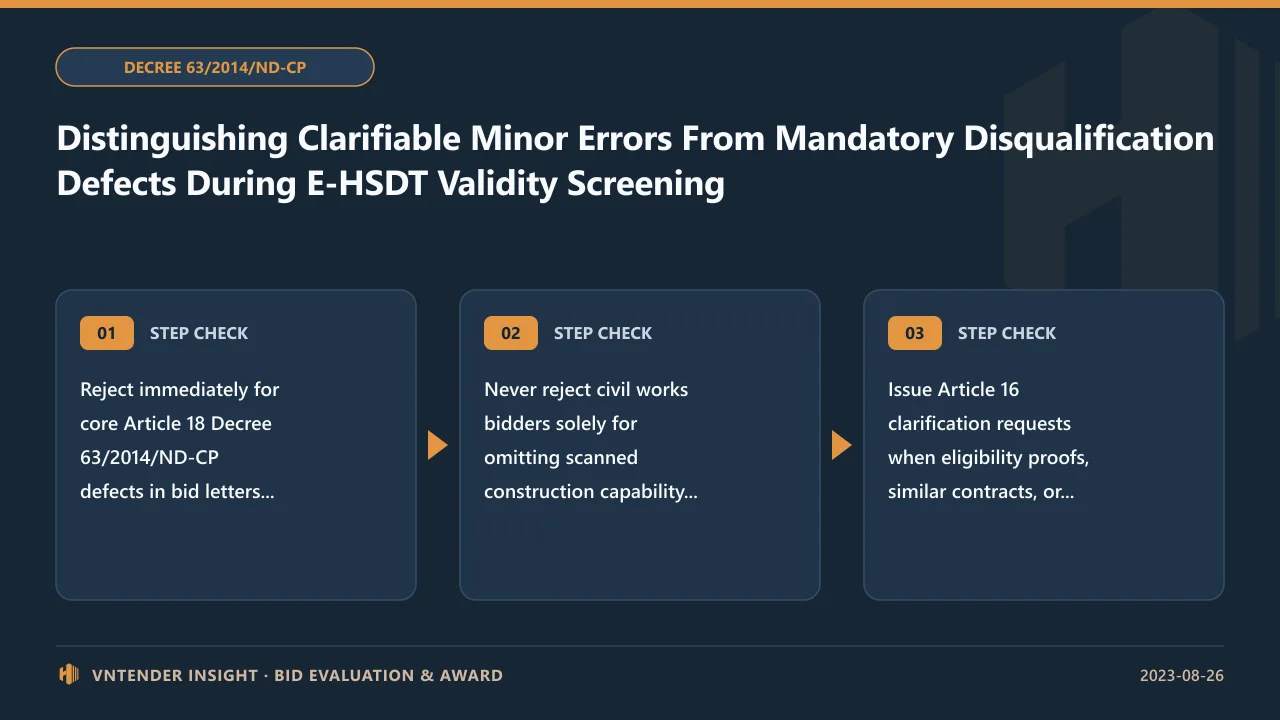
- Reject immediately for core Article 18 Decree 63/2014/ND-CP defects in bid letters, validity durations, bid securities, or duplicate bids.
- Never reject civil works bidders solely for omitting scanned construction capability certificates under Article 28 of Circular 08/2022/TT-BKHDT.
- Issue Article 16 clarification requests when eligibility proofs, similar contracts, or personnel documents are incomplete.
- Ensure post-opening clarifications never alter the bidder's legal identity or modify submitted tender prices.
Legal Basis & Regulatory Scope
Bidding Law 43/2013/QH13; Decree 63/2014/ND-CP (Articles 16 and 18); Circular 08/2022/TT-BKHDT dated 31 May 2022 (Article 28).