Key Takeaways
- Governing Scope: Bidding Law 22/2023/QH15 (Point i, Clause 6, Article 16; Clauses 2, 3, and 4, Article 44.
- Key Benchmark: Audit technical chapters and BOQ sheets to remove single-brand tags outside statutory exceptions.
- Execution Control: Ensure Vietnamese-origin goods remain fully eligible even when regional origin groups are specified.
01Regulatory Context & Core Scope
Across both goods procurement and construction M&E equipment schedules, copying proprietary brand codes verbatim from design drawings or vendor quotes into an E-HSMT is the leading trigger for pre-closing petitions. Clause 3, Article 44 of Bidding Law 22/2023/QH15 bars E-HSMT terms from specifying brand names or origins that restrict competition, while Point i, Clause 6, Article 16 prohibits deliberate specifications that distort equal competition.
02Core Regulatory Provisions & Conditions
Specific brand or origin requirements are lawful only under narrow statutory exceptions, such as ensuring technical or copyright compatibility under Clause 2, Article 44 and Clause 1, Article 56, or packages under Point d, Clause 1, Article 23 tendered competitively by Competent Person decision. Even where an E-HSMT specifies an origin region excluding Vietnam, goods manufactured in Vietnam must still be evaluated on equal terms.
Where purely abstract specs cannot adequately describe complex items, Point c, Clause 9, Article 24 of Decree 24/2024/ND-CP permits citing a reference brand or catalog model strictly for illustration. Doing so legally requires two cumulative steps: placing the phrase 'or equivalent' immediately after the brand reference, and defining objective equivalence criteria inside the technical chapter.
03Evaluation Criteria & Documentary Proof
Writing 'or equivalent' without defining equivalence criteria creates disputes whenever bidders offer alternative manufacturers with minor variations in dimensions or operating tolerances. A compliant E-HSMT must state explicit equivalence benchmarks across technical performance, functional capabilities, technological design, governing standards, operating environments, and spare-parts compatibility.
Before publishing an E-HSMT on e-GP, technical teams should screen MEP bills of quantities, laboratory apparatus lists, and finishing material schedules to strip unnecessary brand tags. Shifting from single-brand model numbers to performance bands safeguards engineering quality while enabling multiple independent manufacturers to compete.
Brand & Equivalence Compliance Checklist
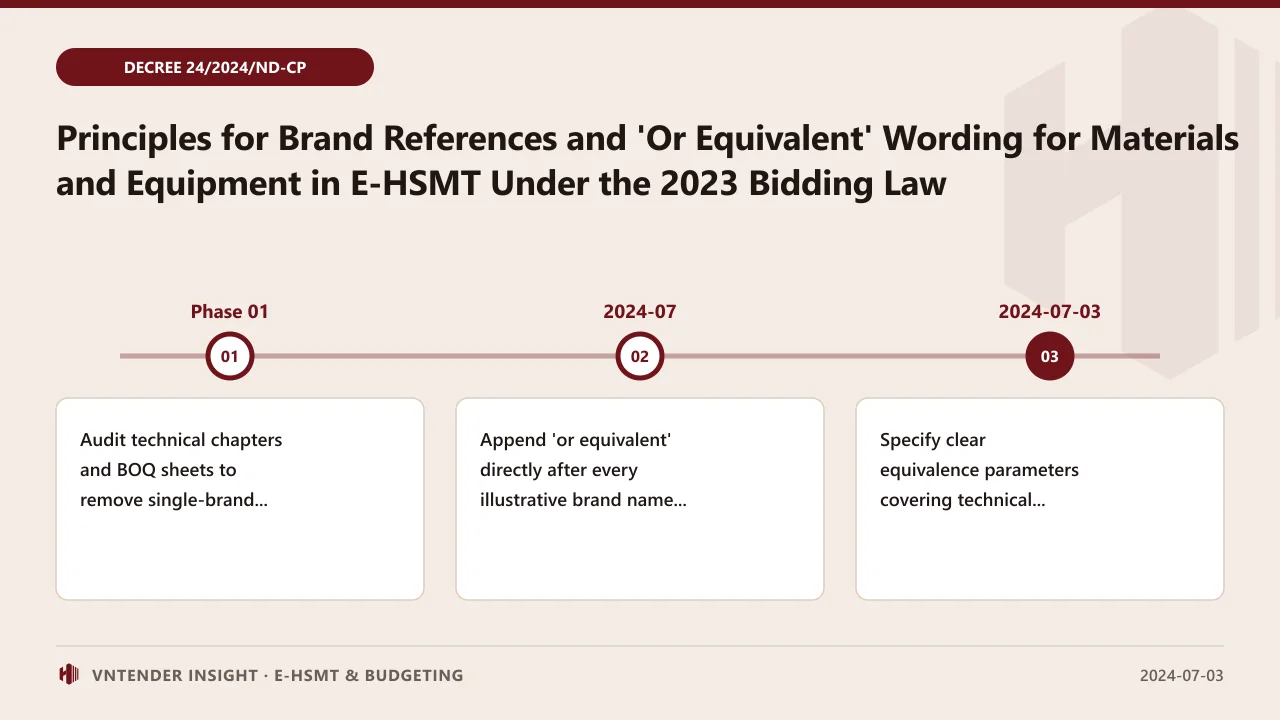
- Audit technical chapters and BOQ sheets to remove single-brand tags outside statutory exceptions.
- Append 'or equivalent' directly after every illustrative brand name or catalog model.
- Specify clear equivalence parameters covering technical metrics, functionality, design, and standards.
- Ensure Vietnamese-origin goods remain fully eligible even when regional origin groups are specified.
Legal Basis & Regulatory Scope
Bidding Law 22/2023/QH15 (Point i, Clause 6, Article 16; Clauses 2, 3, and 4, Article 44; Clause 1, Article 56); Decree 24/2024/ND-CP dated 27 February 2024 (Point c, Clause 9, Article 24); Circular 06/2024/TT-BKHDT (Clause 5, Article 24, and Annex 8).