Key Takeaways
- Governing Scope: Articles 122 to 132 of Decree 214/2025/ND-CP (as amended by Articles 13, 14, and Clause 2 of Article 19 of Decree 349/2026/ND-CP); Clauses 4, 5, and 7 of Article 2, .
- Key Benchmark: Periodic inspection plans follow Form 4.1A under Circular 134/2026/TT-BTC and must reach the inspected entity within 10 days of approval and at least 15 days before inspection begins.
- Execution Control: Submit post-inspection corrective action reports using Form 4.5 within the deadline fixed in Form 4.4 Conclusions.
01Regulatory Context & Core Scope
Alongside greater Project Owner autonomy and expanded direct-appointment cases, Decrees 214/2025/ND-CP and 349/2026/ND-CP strengthen post-award oversight through structured procurement inspections and ongoing monitoring. Effective 9 September 2026, Circular 134/2026/TT-BTC standardizes the full template chain from inspection planning through remediation tracking and public monitoring disclosures on e-GP.
02Independent Appraisal, Petitions & Audit Trails
Under Articles 122 to 127 of Decree 214/2025/ND-CP, the Ministry of Finance, ministries, provincial People's Committees (via Departments of Finance), and Competent Persons conduct periodic inspections under annual plans or ad-hoc inspections via on-site audits or written reports. Periodic inspection plans follow Form 4.1A under Circular 134/2026/TT-BTC and must reach the inspected entity within 10 days of approval and at least 15 days before inspection begins.
For on-site inspections under Articles 128 and 129, the inspection team issues the Inspection Decision (Annex 3), Detailed Plan (Form 4.1B), Reporting Outline (Form 4.2), and Inspection Notice (Annex 4) at least 10 days in advance, opening with an Announcement Record (Annex 5). On-site work lasts up to 15 days (20 days for multi-entity complex audits), with team members retaining statutory dissent rights under Point d, Clause 3, Article 123; upon completion (Annex 6), the team submits Form 4.3 within 45 days, the authority approves Form 4.4 Conclusions within 20 days, and the entity reports corrective measures on Form 4.5.
03Procedural Sequence & e-GP Execution
For Competent Person monitoring and regular agency supervision, Articles 13 and 14 of Decree 349/2026/ND-CP amend Articles 131 and 132 of Decree 214/2025/ND-CP to enforce full transparency. Priority direct-appointment, special-case, and direct-ordering packages undergo progress and outcome monitoring using Form 5.1 of Circular 134/2026/TT-BTC, with all monitoring reports, rectification requests, and Project Owner remediation results published directly on e-GP.
Project Owners and procurement consultants should maintain transaction files structured around the Form 4.2 outline throughout execution rather than reconstructing records upon notice. Proactive archiving substantiates compliance in direct appointments and public-quote pricing and resolves anomalies flagged early by monitoring authorities.
Checklist for Inspection and Monitoring Readiness Under Circular 134/2026
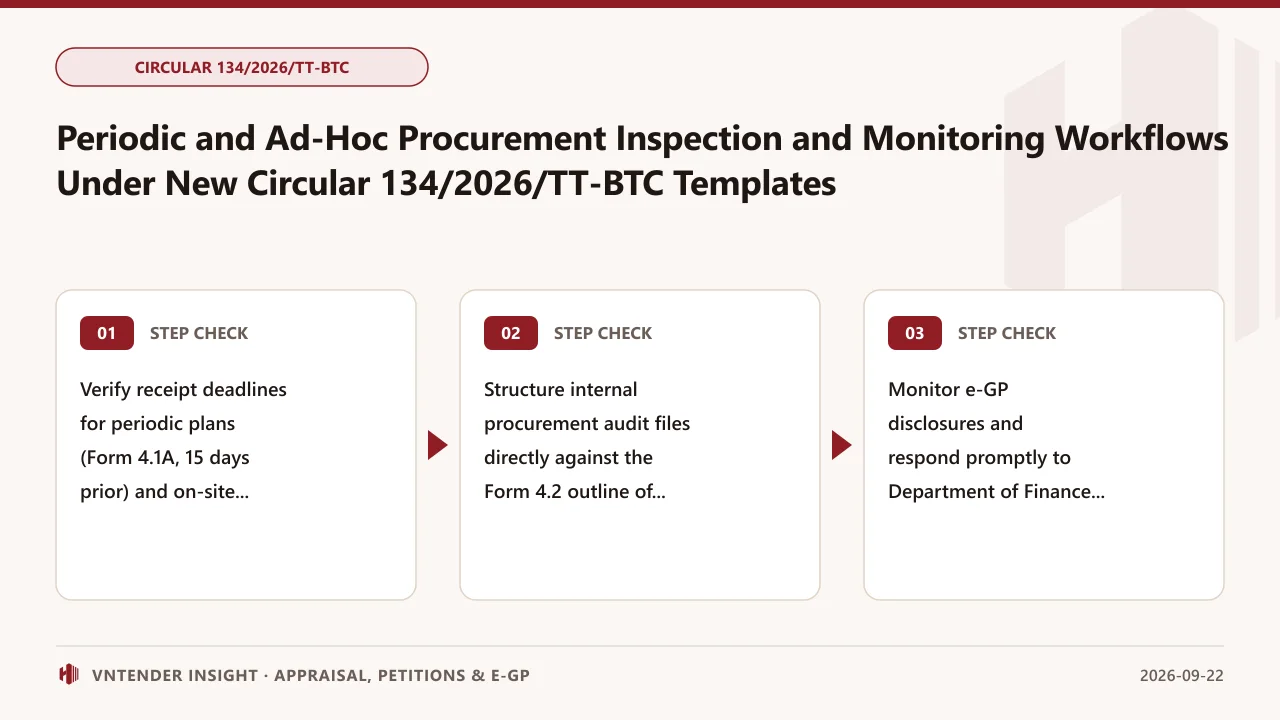
- Verify receipt deadlines for periodic plans (Form 4.1A, 15 days prior) and on-site notices (Form 4.1B and Annex 4, 10 days prior).
- Structure internal procurement audit files directly against the Form 4.2 outline of Circular 134/2026/TT-BTC.
- Monitor e-GP disclosures and respond promptly to Department of Finance or ministerial monitoring inquiries under Articles 13 and 14 of Decree 349/2026/ND-CP.
- Submit post-inspection corrective action reports using Form 4.5 within the deadline fixed in Form 4.4 Conclusions.
Legal Basis & Regulatory Scope
Articles 122 to 132 of Decree 214/2025/ND-CP (as amended by Articles 13, 14, and Clause 2 of Article 19 of Decree 349/2026/ND-CP); Clauses 4, 5, and 7 of Article 2, Forms 4.1A through 4.5, Form 5.1, and Annexes 3 through 6 of Circular 134/2026/TT-BTC.