Key Takeaways
- Governing Scope: Articles 16, 17 (Clauses 1, 2, and 4), and 18 of Bidding Law 22/2023/QH15; Decree 24/2024/ND-CP.
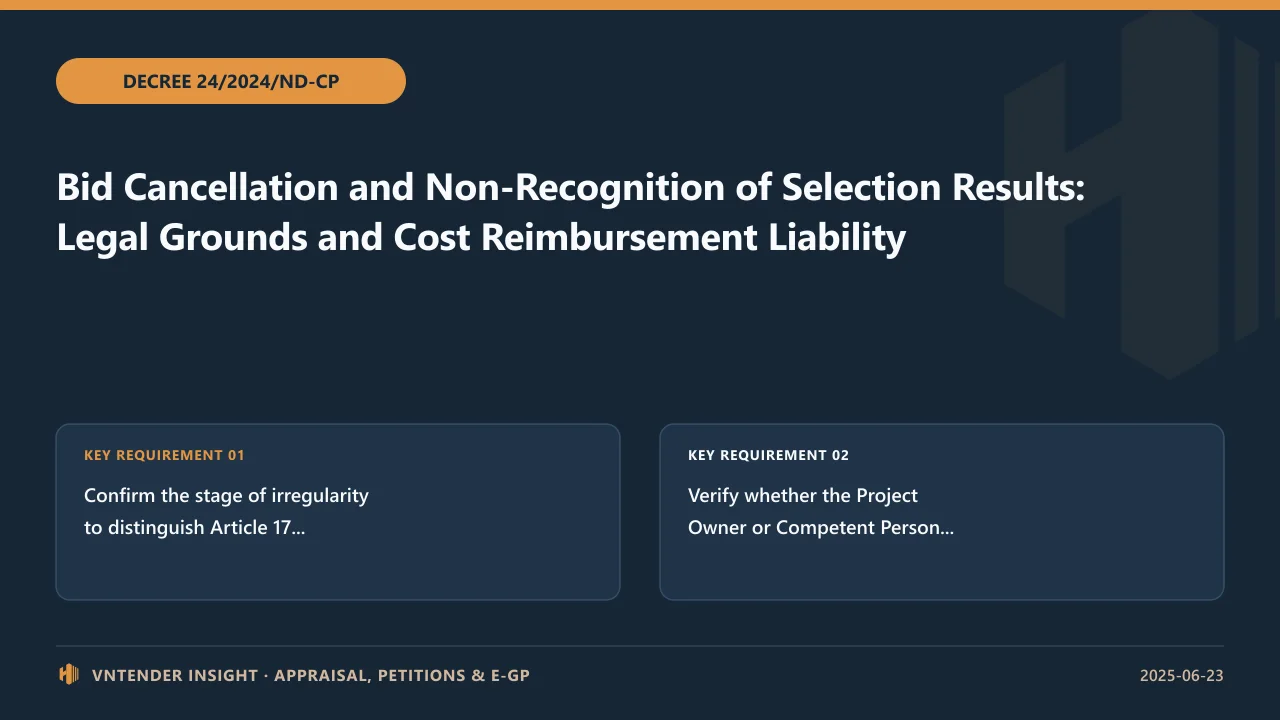
- Key Benchmark: Confirm the stage of irregularity to distinguish Article 17 cancellation from Article 18 suspension or non-recognition.
- Execution Control: Publish cancellation notices and explanatory decisions promptly on e-GP in compliance with Decree 24/2024/ND-CP.
01Regulatory Context & Core Scope
In handling procurement irregularities and bidder petitions, procuring entities frequently conflate two distinct statutory remedies: bid cancellation under Article 17 and non-recognition of contractor selection results under Article 18 of Bidding Law 22/2023/QH15. Invoking the wrong legal ground exposes administrative decisions to formal challenge and complicates claims over bid preparation reimbursement.
02Validity Boundaries & Common Evaluation Pitfalls
Article 17 governs bid cancellation where all submitted E-HSDTs fail E-HSMT requirements, where approved investment objectives change due to force majeure, where non-compliant E-HSMT clauses cause award distortion, or where prohibited acts under Article 16 occur. Depending on the specific clause, cancellation authority rests either with the Project Owner or with the Competent Person.
Crucially, Clause 4, Article 17 establishes direct financial liability: any organization or individual whose legal violation triggers bid cancellation under Points c, d, or dd of Clause 1 or Points c, d, or dd of Clause 2 must compensate affected parties for incurred costs. Compensable items encompass legitimate bid preparation expenses, appraisal fees, and tender administration outlays documented during the cycle.
03Independent Appraisal, Petitions & Audit Trails
By contrast, non-recognition of selection results under Article 18 is exercised by the Competent Person when evidence demonstrates prohibited acts under Article 16 or serious legal breaches distorting the award or undermining fair competition and transparency. While tender suspension applies prior to award approval, non-recognition may be ordered both after award approval and during contract execution.
When publishing cancellation or non-recognition notices on e-GP under Circular 22/2024/TT-BKHDT, the Project Owner should cite exact statutory paragraphs, specify corrective steps, and follow situational procedures under Decree 24/2024/ND-CP. Preserving verified invoices and audit logs ensures any cost reimbursement claim is properly apportioned among responsible parties.
Verification Checklist for Cancellation or Non-Recognition Decisions
- Confirm the stage of irregularity to distinguish Article 17 cancellation from Article 18 suspension or non-recognition.
- Verify whether the Project Owner or Competent Person holds statutory sign-off authority under the relevant clause.
- Document fault attribution clearly in inspection minutes to determine reimbursement obligations under Clause 4, Article 17.
- Publish cancellation notices and explanatory decisions promptly on e-GP in compliance with Decree 24/2024/ND-CP.
Legal Basis & Regulatory Scope
Articles 16, 17 (Clauses 1, 2, and 4), and 18 of Bidding Law 22/2023/QH15; Decree 24/2024/ND-CP; Circular 22/2024/TT-BKHDT; Circular 23/2024/TT-BKHDT.