Key Takeaways
- Governing Scope: Article 89 of Bidding Law 22/2023/QH15 (amended by Law 90/2025/QH15); Clause 5 of Article 33, Articles 137, 138, and 139 of Decree 214/2025/ND-CP (as amended by Arti.
- Key Benchmark: The first track is a non-award debriefing request under Clause 5, Article 33 of Decree 214/2025/ND-CP.
- Execution Control: Publish Council rulings within 2 working days and Competent Person rulings within 5 working days on e-GP.
01Regulatory Context & Core Scope
Once contractor selection results are published on e-GP, unsuccessful bidders often ask Project Owners for detailed reasons behind rejection, yet mistakenly title those requests as formal petitions or wait too long for informal answers and miss the statutory petition deadline. Project Owners and bidders must separate these two mechanisms clearly across legal nature, deadlines, and fees.
02Pricing Methodology & Cost Controls
The first track is a non-award debriefing request under Clause 5, Article 33 of Decree 214/2025/ND-CP. Within 5 working days after award approval, the Project Owner publishes results together with a summary of non-selection reasons. Where that summary lacks detail, an unsuccessful bidder may request further explanation in writing or in person, and the Project Owner must respond within 2 working days at zero cost to the bidder.
The second track is a formal procurement petition under Article 89 of Bidding Law 22/2023/QH15 and Articles 137 and 138 of Decree 214/2025/ND-CP as amended by Article 15 of Decree 349/2026/ND-CP. For award petitions to be admissible, the bidder must submit a signed petition to the Project Owner or directly to the Standing Unit supporting the Petition Resolution Council within 10 calendar days of award publication on e-GP, and pay the required petition fee if escalated to the Council.
03Procedural Sequence & e-GP Execution
Decree 349/2026/ND-CP reinforces response timelines: when receiving an award petition, the Project Owner must issue and upload its decision on e-GP within 7 working days; if escalated within 5 working days thereafter, the Petition Resolution Council issues its ruling within 30 days (extendable by up to 10 days for complex disputes under new Clause 8, Article 138), and the Standing Unit publishes that decision on e-GP within 2 working days of issuance.
A frequent bidder error is assuming the 10-day petition clock pauses while awaiting an Article 33 debriefing. In law, the 10-day limitation runs uninterrupted from e-GP result publication. Bidders should request an Article 33 debriefing immediately within the first two days so they obtain the 2-working-day response in time to file or forego a formal petition inside the 10-day window.
Clarification Request vs Formal Petition under Decree 349/2026/ND-CP
| Dimension | Selection Explanation Request | Formal Award Petition |
|---|---|---|
| Filing Window | After KQLCNT notice (does NOT pause 10-day limit) | Strictly within 10 days of e-GP KQLCNT publication |
| Statutory Fee | Free of charge | Petition handling fee required if escalated to Advisory Council |
| Response SLA | Employer responds within 02 working days | Employer 07 working days; Advisory Council 30 days (+10 days) |
Checklist Separating Debriefing Requests From Formal Petitions
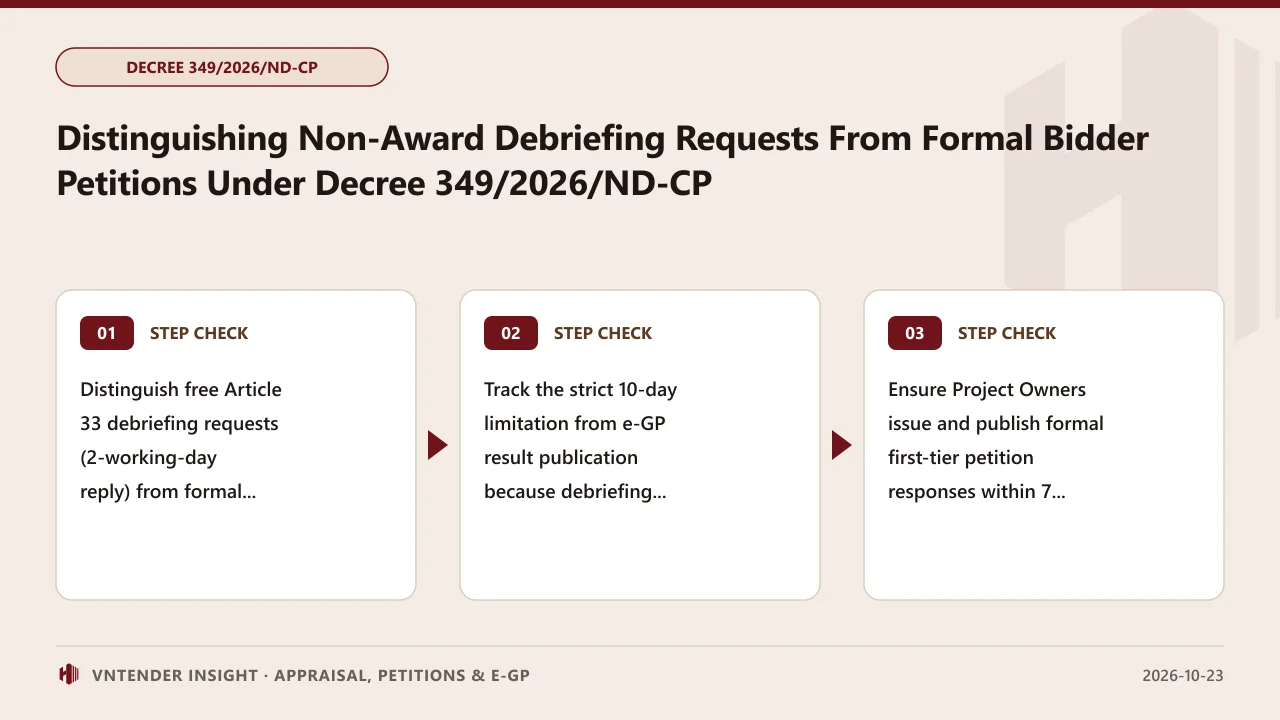
- Distinguish free Article 33 debriefing requests (2-working-day reply) from formal petitions requiring Article 137 admissibility checks.
- Track the strict 10-day limitation from e-GP result publication because debriefing requests do not toll petition deadlines.
- Ensure Project Owners issue and publish formal first-tier petition responses within 7 working days under Article 15 of Decree 349/2026/ND-CP.
- Publish Council rulings within 2 working days and Competent Person rulings within 5 working days on e-GP.
Legal Basis & Regulatory Scope
Article 89 of Bidding Law 22/2023/QH15 (amended by Law 90/2025/QH15); Clause 5 of Article 33, Articles 137, 138, and 139 of Decree 214/2025/ND-CP (as amended by Article 15 of Decree 349/2026/ND-CP).