Key Takeaways
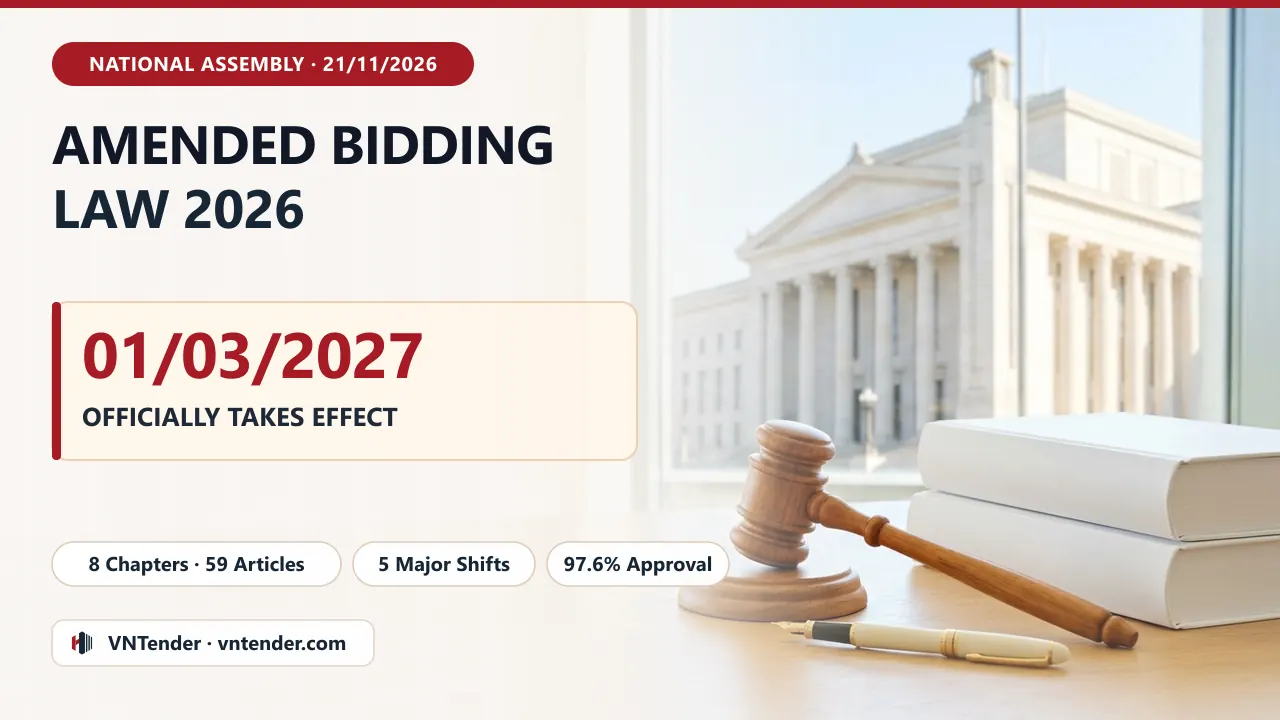
- Scope & Effective Date: Passed on 21 November 2026 (487 of 489 votes, 97.6%), streamlined to 8 chapters and 59 articles, effective 1 March 2027 (Clause 4 Article 35 effective 1 July 2027).
- Five Core Shifts: Government decree sets direct contracting caps and direct-order rules, contract amendments are restricted to pre-defined signing grounds, single-quote budgeting narrows, and prime contractors retain full liability.
01. National Assembly Approves Streamlined 59-Article Bidding Law
On the afternoon of 21 November 2026, at its second session, the 16th National Assembly formally passed the amended Bidding Law with 487 out of 489 voting deputies in favor, representing 97.6% of all National Assembly members.
The revised statute condenses the framework into 8 chapters and 59 articles, replacing Bidding Law 22/2023/QH15 (previously 10 chapters and 96 articles). Its official law number will be assigned upon presidential promulgation.
- General effective date: 1 March 2027 across contractor selection and procurement governance.
- Grassroots healthcare exception: Clause 4, Article 35 takes effect on 1 July 2027, allowing commune-level health stations to sign supply contracts for medicines, testing reagents, medical consumables, and medical devices based on valid procurement results of public hospitals.
02. Five Core Changes Affecting Project Owners and Bidders

Presenting the revision report on behalf of the Government, Minister of Finance Ngo Van Tuan emphasized balancing procedural agility with strict risk controls and personal accountability.
- Tightened direct contracting criteria and decree-based monetary caps: The Law restricts direct contracting to urgent, emergency, national defense, security, and state-secret packages, while allowing controlled direct contracting and direct ordering for strategic sectors, special R&D, innovation, and digital transformation. The Government will specify monetary thresholds and eligible direct-order goods and services by decree to match market price fluctuations, while Project Owners retain full discretion to run open competitive bidding.
- Strict limits on contract amendments: Contract terms must mirror the bidding documents, submitted bids, and award decision at signing. Amendments are permitted only for contingencies expressly defined when the contract was executed, preventing post-award changes that distort selection outcomes.
- No rigid subcontracting percentage cap, full prime contractor liability: Rather than imposing a fixed statutory cap on subcontracted work, the Law keeps flexibility by package scale while holding the prime contractor solely accountable to the Project Owner for total volume, quality, schedule, and performance, including all work executed by regular and special subcontractors.
- Narrower use of a single price quote for package budgeting: The Government will curtail reliance on a single quotation when establishing package prices, enforcing transparent solicitation and encouraging benchmarks built on the average of multiple quotes alongside historical winning prices for comparable goods and services.
- Clearer institutional autonomy and strict ban on package splitting: Article 1 covers projects and procurement budgets using state budget funds and lawful revenues of state agencies and public service units. State-owned enterprises and public service units gain greater autonomy over non-state-budget procurement, paired with mandatory publication of internal procurement rules on e-GP and strict prohibitions against splitting packages to bypass open tendering, collusion, or withholding clarification records.
03. Practical Action Plan Before 1 March 2027
From 23 November 2026 through 28 February 2027, ongoing procurements remain strictly governed by existing law. Project Owners must not cite uncommenced provisions of the 2026 Law in current E-HSMT templates.
- Follow active 2026 rules during transition: Continue applying Bidding Law 22/2023/QH15 (as amended by Laws 57/2024/QH15 and 90/2025/QH15), Decree 214/2025/ND-CP (as amended by Decree 349/2026/ND-CP), and Circulars 79/2025/TT-BTC, 134/2026/TT-BTC, and 168/2026/TT-BTC.
- Verify e-GP templates published from 21 November 2026: Ensure bid security wording matches Forms 04A, 04B, and Annex III under Circular 168/2026/TT-BTC.
- Prepare 2027 procurement pipelines: Segregate state-budget packages from non-budget SOE or public-unit packages and standardize multi-quote pricing records and contract-amendment triggers.
Review active 2026 monetary thresholds, e-GP quotation deadlines, and standard checklists anytime in the VNTender 2026 Procurement Lookup Tool.
Legal Basis & Regulatory Scope
Amended Bidding Law 2026 passed by the 16th National Assembly on 21 November 2026 (8 chapters, 59 articles; effective 1 March 2027, with Clause 4 Article 35 effective 1 July 2027). Until 1 March 2027, tenders continue under Bidding Law 22/2023/QH15 (as amended by Laws 57/2024/QH15 and 90/2025/QH15), Decree 214/2025/ND-CP (as amended by Decree 349/2026/ND-CP), and Circulars 79/2025/TT-BTC, 134/2026/TT-BTC, and 168/2026/TT-BTC.
Cổng Thông tin điện tử Chính phủ (Xây dựng chính sách, pháp luật): https://xaydungchinhsach.chinhphu.vn/thong-qua-luat-dau-thau-sua-doi-119261123153004344.htm; Quốc hội nước CHXHCN Việt Nam (Kỳ họp thứ 2, Quốc hội khóa XVI ngày 21/11/2026).